Near Union Square, behind a plaza and a closed school, you can find a community center. There, some religiously attend Friday mahjong nights. Some tote their gym bags in, ready for an intense volleyball or basketball game after work. Some come from Allston-Brighton, while others go out of their way to come to the neighborhood from Dorchester and the South End. Others knit, and, still, others learn guitar.
For decades, these neighbors have made a gymnasium, a dance room, and some classrooms come to life at the Jackson Mann Community Center, a Boston Center for Youth and Families (BCYF). While its reconstruction has been in talks for years, the City moved one step closer to deciding on the future of the community center on Tuesday.

The planning meeting was the last of three formal community meetings about how the site on which the community center currently sits would be used, which would be some configuration of the community center with either housing or a public school. A proposal about the site’s usage would then be presented to Mayor Michelle Wu and either accepted or rejected.
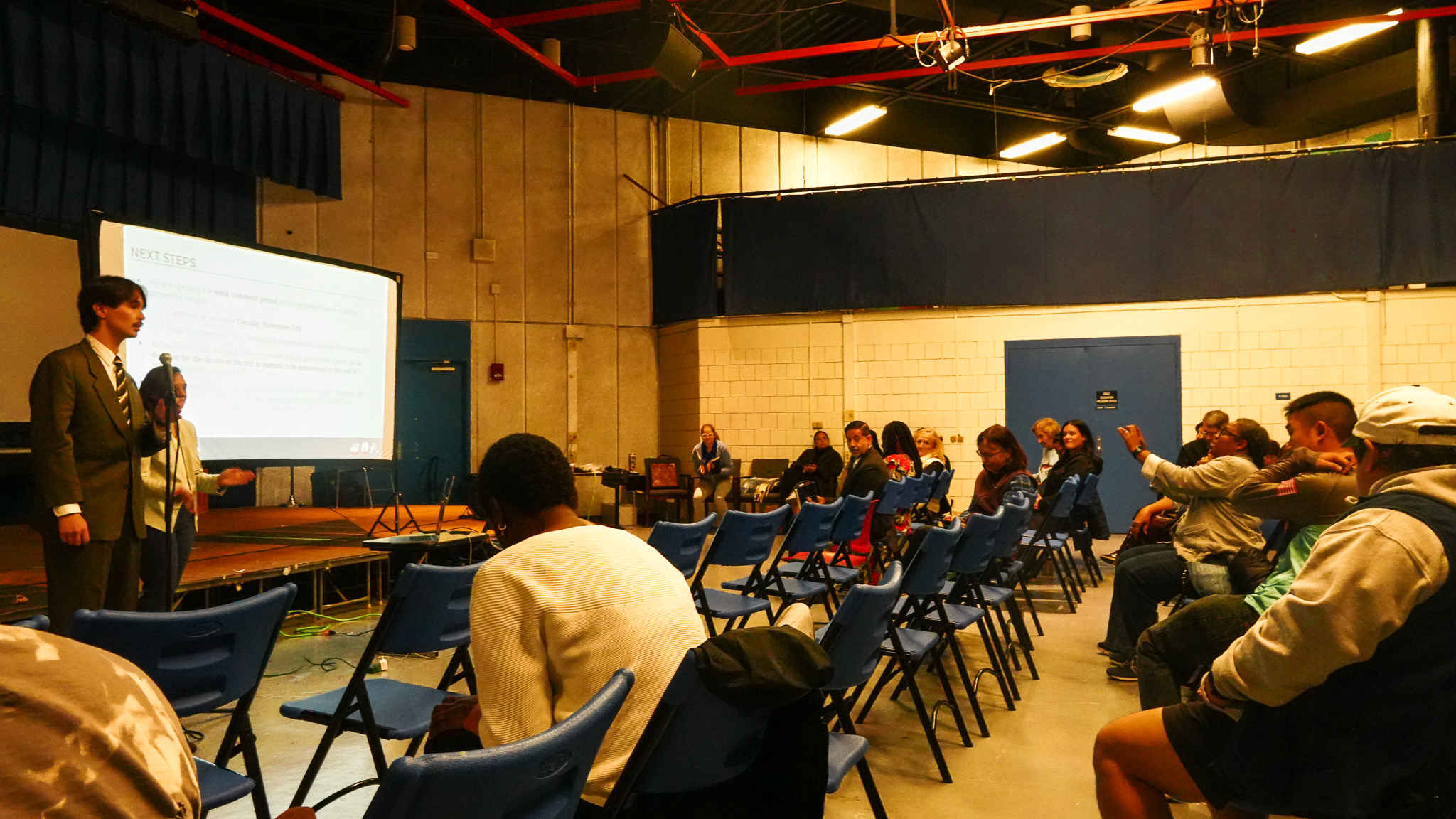
“We’re trying to narrow it down so that we can meet our goal of finalizing what the site will be found by the end of the year,” said Patricia ‘Trish’ Cafferky, who works at the city’s Operations Department and led the presentation Tuesday night.
At this meeting, city officials showed a draft of this proposal and received comments and questions from community members.
Details of the draft proposal
The proposal indicates that the city is narrowing down on a final decision for the public use of the community center. At meetings earlier in the summer, much of the discussion surrounded whether housing or a public school would accompany the redevelopment of the community center on the site. Following the release of results on the second survey during the meeting, the city presented a draft proposal for a community center with affordable or mixed-income housing, but no public school.
The proposal would place the community center on 500 Cambridge Street while housing would be located behind it on Armington Street. As part of the proposal, there would also be a search for childcare opportunities or potential retail space on the site.

The draft proposal will now be finalized and sent to Mayor Michelle Wu, who will make the final decision by the end of the year. If it is approved, Cafferky and her team would begin working to transfer ownership to the city because Boston Public Schools formerly had two public schools on the site and still retains partial ownership of the site. Planning for the community center and the housing request for proposals (RFP) would also begin in early 2027.

While the site is being developed, city officials are planning for the community center to be relocated to the Taft Building, which is located at 20 Warren Street. It most recently held the Boston Green Academy, who will vacate the building by the school year 2028. If the community center needs to be relocated prior to 2028, the city is also studying Brighton High School as a possible co-location.
“The timeline for this proposal is one that many people have seen before, so it basically looks like as soon, as we settle on — if this is it — we would move into design and housing RFP together,” said Cafferky.
Some neighbors call for Boston Public Schools to invest in Allston-Brighton
While BPS indicated that it would focus on investing in current schools or expanding elementary school seats in Allston-Brighton (as opposed to building a new school at the Jackson Mann), neighbors expressed concerns during the meeting that the needs of current and future public school students in the neighborhood were not being met by BPS and the city.
“I’m on the parent council of the Winship School, and I can just give you a picture of what’s going on there,” commented Hazel Ryerson, an Allston resident. “When it rains, PE [physical education], recess, and cafeteria are all competing for one small space, and the kids end up, inside on screens during the recess time. The month of February last year was really cold. The kids didn’t get out. They didn’t get PE or recess for an entire month.”
“We need to see significant capital investments in the Allston-Brighton public schools. I want to see that on the proposal,” she concluded to applause.
Allston-Brighton has been experiencing several changes in its public schools infrastructure. As part of a broader school closure and consolidation movement by BPS, the Mary Lyon Pilot High School closed this past school year, while the Edison K-8 School and Gardner Pilot Academy stopped offering seventh and eighth grade in 2024 and 2025, respectively. In addition, Boston Green Academy is planning to move out of Allston and return to a redeveloped location in South Boston in 2028.
“What would really help to restore trust is if someone from [Boston Public Schools] administration would actually acknowledge that yes, we have underinvested in this neighborhood, and we think we should fix that,” said one neighbor during public comment. “Not all my kids went to BPS, but all of them might have.”


Alongside the neighbors who pressed for greater investment in Allston-Brighton’s public schools, Nikhil Dasgupta emphasized a related need in Jackson Mann’s proposal: affordable housing that would allow families to stay in the neighborhood and use those schools.
“A big part of that problem is that it’s not affordable to live and have families,” said Nikhil Dasgupta. “When we have the opportunity to increase housing supply, create affordable housing space for people to have families here, who can then use the resources that we desperately want to invest in.”
Neighbors have until Tuesday, November 17 to send comments about the draft proposal to city official Francis Mendoza-McCarthy via email at Francis.MendozaMcCarthy@boston.gov. They can access the slideshow from the planning meeting here.