
|
Getting your Trinity Audio player ready…
|
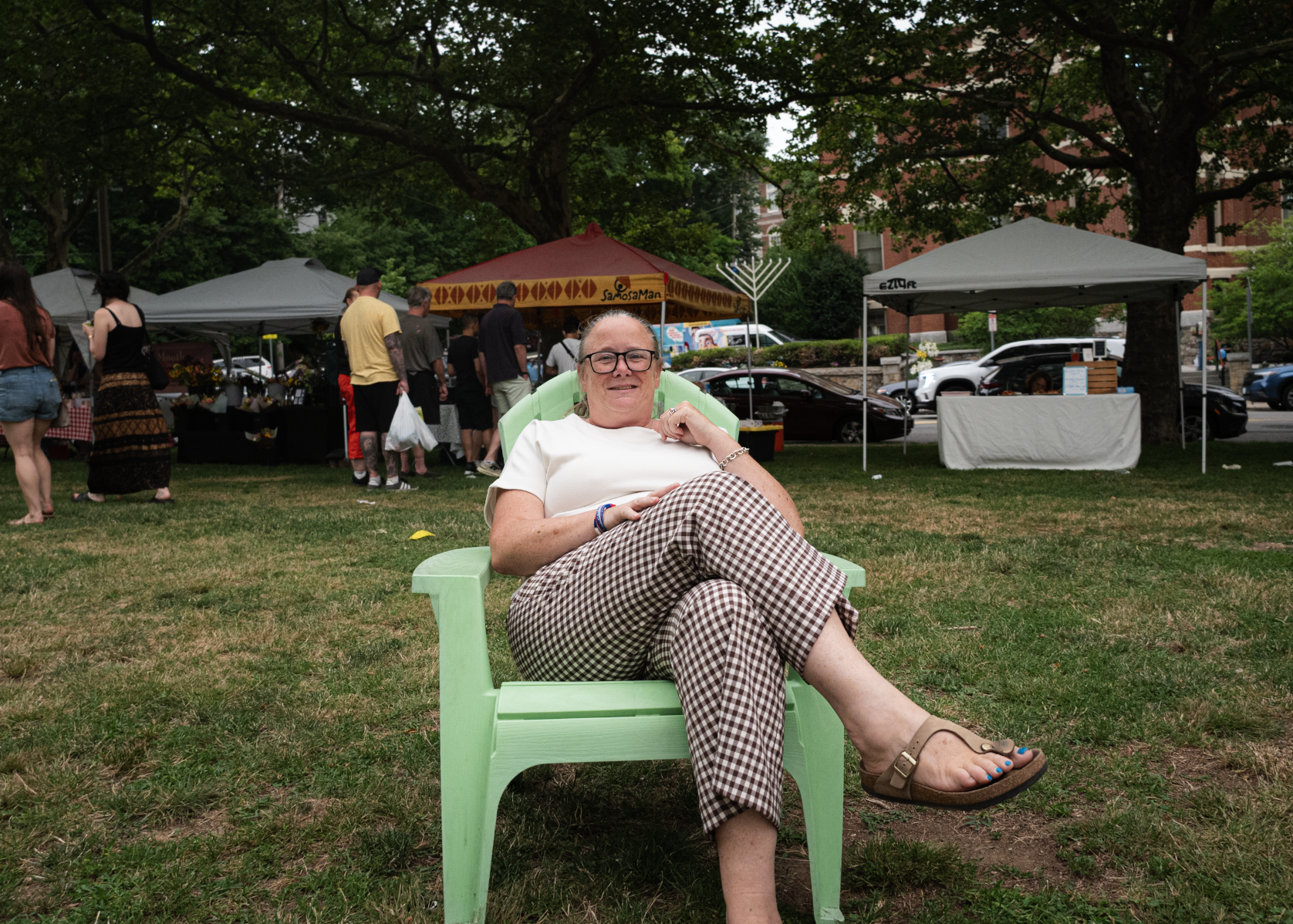
We meet Kelly McGrath, a born-and-bred Brightonian and executive director of Brighton Main Streets, at Brighton Common, where the weekly farmer’s market is being run.
A band from the youth community center West End House is playing. McGrath doesn’t mind the loud music, perhaps a callback to her days dancing with her friends in Allston Brighton. Her no-nonsense quips and love for the neighborhood are endearing to us.
Where did your relationship to Brighton begin?
It began at Saint Elizabeth’s Hospital on October 31st, 1970. That’s where I was born. My mother started out in Dorchester when she was very small, but then they moved to what’s known as Commonwealth Fidelis. It was Fidelis Way back then after the war, World War II, that is. My grandfather fought in World War II, so that brought them to Brighton. I did not grow up there. My mother grew up there. And I did live there for a little bit when my parents first divorced, but then I lived on Mapleton Street, and then I moved to Parsons Street when my mother remarried. I’m in my childhood home.
So, what was it like growing up in Brighton?
I went to St. Columbkille all 12 years, one through 12. Growing up in Brighton, there was tons of families and tons of kids, and it was a great place to grow up. There’s a lot less kids now, I feel, and maybe less families. For example, there were three or four little leagues, and now there’s just one, right? You played in the little league. It was tough to get girls enough teams, and we had to go out to Watertown. That was not a problem growing up in Allston Brighton, we had so many kids and so many families, but the affordability, I think, drove a lot of the young people out when they got married. You know, they moved on, and you know the schools, all sorts of reasons for that. But we had so many resources.

Growing up, during the summer we had we didn’t really go to camps. There were camps, but we didn’t really go. But the Jackson Mann, the West End, all those resources were available back then too. I didn’t go to the West End, but I did do Jackson Mann. We did dancing. We did ceramics. We did. We did all sorts of ceramics. They had ceramics at Jackson Mann. The kiln is still there. It’s in the hallway. I saw it last week.
Then after St. Col’s, did you leave Brighton for a bit?
I went to Salem State College in Salem, so I did go to school for years. But then I came back, and I did when I first got married. I tried to live in the suburbs. It was bad for me. I lived in North Andover for eight years.
When my daughter Olivia was born, we lived in North Andover, and then we moved back in right when she was going into second grade. We came back. My parents were going to move downstairs to downsize. My mother had some health issues, so she wouldn’t go up and down the stairs. So she said, “If you want to come back, this is your opportunity.” And I said to my husband, “I want to go back.” So, I’m back.
Were your parents bigger fans of you, since your brother left for San Diego and you stayed in the Brighton area? I’m definitely the favorite. You can quote me on that.
What were your 20s and 30s like in Brighton?
I’ll tell you, my 20s and 30s were probably the best times of my life. We had so much fun around here. Every place in Allston Brighton was filled with people. There was dance clubs and bars, and everybody was out five to seven nights a week. Honestly, it was a great place to hang out and be in a college town because there was so much happening. I mean, some of the best times in my life.
What were your favorite places from your 20s and 30s?
We used to hang around a place called Joey’s, and now it’s the nail salon. We call it Joey’s, but that’s not the name. It’s Moonlight Nail and Spa, right over on Market Street. We used to hang around there all the time. It was so much fun. We had a great time.
Let’s see, Devlin’s and Porter Belly’s — they’ve been around a long time, and there are really, really great people that own that. And I still go in there and hang out. I was texting with Tom Devlin earlier. They’re great people. The Green Briar, where Peka is now, was a huge place that everyone used to gravitate towards.
Down on Harvard Ave [she says it like HAH-vahd], there were tons of places down Harvard Ave to hang around and on Bright Ave. The Kells was a huge one. Now it’s the new. It’s all different restaurants inside it. I think it was Tavern on the Square. So that was a huge dance club back in the day. And before it was The Kells, it was Molly’s, which was a big place, a big dance club that everyone went to. Dancing was a huge thing.
Was it expensive to get in?
Maybe five bucks or something to get in.
Would you go out with your man or with the other big group?
Everybody went out. Guys, girls, everyone together.
How did that group come together? Was that your old friends that you went to stay college with, and everyone just brought in their people?
Every school because we had friends at Brighton High, we had friends at John Bosco, an all boys’ school back in the day. Catholic Memorial, all the schools. Mount Saint Joseph’s was the all girls’ campus school. Latin Academy. There was a big club when we were teenagers, CYO, which was the Catholic Youth Organization, so they would have all sorts of things for the kids to do.
We had a drop-in center, which was where the rectory is, where the priest lived. At St. Col’s behind it, there’s a secret door to the — not a secret door, but there’s a door to the basement, and that used to be a teen rec center that was open two nights a week that we used to go and just watch TV, play pool down in the basement of the free source. Isn’t that funny?

It was a lot of fun. We hung around in the schoolyard. People hung around in Ringer Park, Smith Field.
Into your 40s and 50s, could you talk about where your involvement in the Brighton community might have evolved?
I was always definitely community involved, probably because of my parents, and probably because I’m growing up, going to St. Col’s, volunteerism was a big thing in school. So the sisters of St. Joseph were definitely major influencers. My parents — they were involved in the Little League, and they were involved in all the civic stuff and the politics. My father coached my mother and father both coached, and my father coached baseball, paraleague baseball for 30 years, which was the men’s adult league. But they coached everything in little league. Everything. My father coached softball as well. All the parents did. All the parents did. That was huge.
And then, so my 40s and 50s. After I moved back from North Andover, I was working in the healthcare industry because I did work at Lawrence General Hospital. I was a lab manager. I managed phlebotomists and labs. Once you’re a manager of people, you can kind of do it anywhere. So then when I moved back, I couldn’t keep traveling back and forth to Lawrence. It was too much, and I took a job for Steward Healthcare, which owned St. Elizabeth’s at the time. But I worked in Weston for some OB/GYN doctors, and then Olivia’s schedule just got too active, so I went part time.
And then I started bartending and waitressing, so that I could have more flexibility around here. I worked at the Corrib for three years, and then I managed the Elks Lodge several years, and I was doing that. And then the job for Brighton Main Streets came up, and I said, “Oh, I’ll apply. And if I don’t get it, who cares?” But then I got it, so now, here I am.
What did you have to talk about in the application?
I had to do a PowerPoint presentation for the job, and you had to basically present to them ideas and what you would do for the community and your vision and things like that.
And I’ll never forget the interview. I walk in with my PowerPoint presentation, and the computers didn’t work, so we had to draw on some paper. But I won the job. There was one woman up against me.
Do you take up bartending as a gig still? You know what? I do. If the Corrib gets stuck with somebody, I do. I just waitressed a week or two ago.
I get to see all the people that I miss seeing all the time being there on a more permanent basis. And how I started working at the Corrib, they had a long-term waitress, Franny Miller, who worked there for over 40 years, and she got sick. And she was always trying to get me to waitress there, and I kept saying no to her. When she got sick, I said, “All right, I’ll do it for you. And when you get better, you better come take your job.” Unfortunately, she did not get better, so I stayed three years. and I still, if they get stuck and I can manage it, I can fill in for them. It’s a great skill and a great way to make money.
Do you have any favorite drinks to make for people? Any tips for beginning bartenders?
I like when people just drink beer, I’ll be honest with you, and if it’s a two-ingredient drink, the better.
But with the Elks, it was easy because it’s the same people all the time. You get to know what they like, and it’s easy. But it’s fun learning how to make these drinks too. But practice makes perfect. I will tell you the main thing with making mixed drinks is don’t think that you’re doing them a favor by doing a heavy pour because the drink doesn’t taste good. You gotta keep it balanced. One ounce shot glasses, if you can, to mix them evenly.
I don’t mind making espresso martinis, to be honest with you. There’s all different ways to make them. I don’t mind making those.
Could you describe the different crowds? Was Brighton Elks different from the Corrib Pub, for example?
So the Brighton Elks is a private club. But you could get all different generations of people, and I guess the Corrib is sort of like that too. But a lot of regulars at the Corrib, Irish. They all sit at the same end of the bar. There’s all sorts of people that come in there and hang out. It’s a great place. It’s price point wise, food. I mean, you can’t beat it. There’s nothing on the menu that’s over $25 for a meal, and they give you huge portions, and the food is delicious. And they’ve been there over 55 years, I think.
And they have given, you know, a lot of the immigrants that come over from Ireland. I mean, he’s given so many people jobs. Throughout the years, he’s made living possible for a lot of young Irish folks that have come over. He was one of those people, Huey Bligh, and he still goes to work every single day. When he’s not, you know, away in Florida or something, but he’s there. If he’s around, he is there every day, and he’s in his 80s. He’s still doing the books and he’s still managing the operation.
Taking on your role at Brighton Main Streets, what was that like? What were the challenges, and what have learned, running a role like that?
I think the hardest thing was the first year was just getting to know people — I mean, I knew a lot of people — but I didn’t know a lot of the business owners, and a lot of the business owners are immigrants who don’t speak English very well. So that’s been not the easiest. Sometimes we make it work, but just getting to know the people. A lot of the time, it’s not even the business owners; it’s just the people that work there every day. So you don’t get to know the business owners necessarily. So that was the first year, just getting to know people. And you know, trying to keep the programs that we had and then expand on them.
Allston Brighton businesses have diversified a whole bunch. You mentioned the difficulty that might come with reaching out to more immigrant entrepreneurs. What have you been thinking about when it comes to approaching these sorts of businesses or showing up for them?
Just finding ways to be creative. The guy at Sweet & Comfy, for instance, he doesn’t speak English, so we talk through Google Translate. If I have to tell them something, we do it that way. Even the people at New Work Spa downstairs from Brighton Main Streets, they don’t really speak English. And if we have to talk, it’s usually through email. But we figure out a way to make it work.
Looking back on five years of this work, what are the ways that you supported this community?
I think that having the neighborhood programming, the trick or treat, brings tons of foot traffic. The community egg hunt brings tons of foot traffic. We did a holiday pub crawl this year. We’ve expanded our youth outreach and youth mentoring with the kids at Faneuil and the families at Faneuil and the families at Commonwealth Fidelis. We’ve done a lot of work with the kids at Brighton High, especially the sports athletic teams, to try to bring them into the community. Some of those kids have never even been to Brighton Center. So, you know, introducing them to some of the restaurants and the businesses up here has been fun.

Can you describe the proportion of what your work looks like? For instance, is it 20% talking to the city, or 50% fundraising?
I try not to talk to the city at all if I don’t have to. Because, I mean, we just do our contracts with them. We report to them monthly with different surveys and things like that that they have us do, just to make sure that we’re following parameters according to contracts. But I don’t have to check in on a daily basis with them or anything. I have a board of directors that I check in with, but I’m a party of one. I do have a part-time employee who does my website work and does some marketing stuff behind the scenes, and I do have two interns this summer. But other than that, it’s just me. So I write all the grants. I do all the outreach. I go to all the community meetings. I sit on a lot of different boards, just because it’s some stuff I love to do.
But it’s also ways to make partnerships, and why I have an easier time maybe outreaching to people when I need to help others in the community. I can say, ‘Hey, this is going on,’ and we come together as a group, and we make it work, like the Youth Athletic Committee that helped bring back BNBL — who got the Little League rebuilt with a brand new board. That all came from the Youth Athletic Committee.
How do you project manage?
It’s a lot of chaos. I thrive in chaos, to be honest with you, I do. But you just have to make it a priority. And now that Olivia’s older and off to college, I have more time. I’m an empty nester, so it keeps me busy. But it’s good busy, and I love to do it.
We just got a grant award from VIP, Violence Intervention and Prevention, which is part of Boston Public Health Commission. And so a couple of years ago, a young man was shot down in Allston, and they actually just arrested the person that was responsible for that. And out of that grew a sense of Allston Brighton is sort of never really looked at as a community that has those issues, but we do have some issues with our kids and providing resources and making sure that that number doesn’t grow, right? We don’t want to have more problems, so we reached out to the Office of Violence Prevention at the City of Boston, and we brought them over here for a meeting with a group of us, the youth athletic people, and that group of all our organizations. And Isaac Yablo came over and sort of said, you know, Allston Brighton needs to be in the discussion, and that led to an opportunity to apply for a grant, which I’m happy to say that Brighton Main Streets got the grant, and we will be doing work with Commonwealth Fidelis and Faneuil.
The money only can only be spent in those two developments, but we’re going to start doing more programming, which we had, with the kids there and the families, and we had already been doing mentoring with the kids at Faneuil Gardens, anyways, with the Brighton Future Forward with the Allston Brighton Community Development Corporation. So we’re just going to expand on that, and then we’re going to introduce a lot of stuff up in Commonwealth Fidelis too, which I’ve already started working with Sindy Perez, the head of its Local Tenant Organization, and I have partnerships with Margarita Lebron and Sonya Owens at Faneuil Gardens. So we’re all just working together to spread this love around to everybody.
Once you step out of this role, for your next person, for your successor, what sort of lessons would you have? Looking back, where would you say someone else could grow on the work that you’re doing?
For example, hope that whoever comes after me is somebody who is as passionate and loves Allston Brighton as much as I do, and wants to really do good things for their community and make it. To be really meaningful because it’s, I think it’s important. I’m always saying we’re looking for the next people. That’s why when people come to me and say, “Oh, I would love to come work for you,” like I with these two young ladies, they approach me. I didn’t have plans really to hire anybody, but I said, you know what? They were so proactive reaching out to me, and I want to find the next generation of me and of Danny friends and of yourselves, you know what I mean. Kind of so involved in the community, so we need to build that, especially because, you know, we’re so heavily rental and not really home ownership, which I wish we would get back to a little bit for people to really plant roots.
I’m not saying you have to own a house to plant roots, but you tend to plant better roots if you have something to stay for, so, you know, I want the kids that grew up here to have the same experience as I did. It’s not going to be as much, but we could bring it back. That’s why I wish. I hope, with the Jackson Mann, when the new community center comes, I’m going to be honest with you. I’m hoping it’s a school. You know, I know a lot of people don’t agree with that, but I would like it to be a school. I think we deserve a new school, a new state of the art, and they could put housing in all the other schools that are old and decrepit.
What makes Allston Brighton special for you?
I think that Brighton and Allston are very special. My college friends said they came here to visit with me. I brought them somewhere. I brought them to a party or something, and they said, “We’re never gonna see you after college.” And I said, “Oh, don’t be crazy. You’ll see me after college. We’ll be friends forever.” And you know what? They were right. And everyone I know from Brighton feels the same way. It’s just — it’s a very special place. I think it might be a City of Boston thing, maybe with the neighborhoods and everything. But I don’t know. I do think there’s something special here.
What are the places that you tend to frequent now in Brighton?
So the Corrib, obviously, I like the Corrib. I like Devlin’s. I try to frequent all of them and the Stockyard. I love what they’re doing down on Guest Street. I love the Speedway. I think Lower Allston is gonna be the spot to be in at some point. It’s starting now. So many great places. I love to go everywhere. I don’t. I mean, of course, I have my old neighborhood staples, but, you know, there’s a lot of community.
The Corrib does the annual holiday toy drive. You know, the Elks has the Brighton Bazaar, but then they have the Speedway too. I’m particularly proud of the Brighton Bazaar people because they got the shot at the Elks with me, and they have expanded so much, and now they have their own storefront, which is so huge. The Brighton Emporium, to see them grow, and now they’re expanding down. They’re doing the Newport Elks. They’re doing so many other venues around town. They’ve really blown up, so I love that. I love that. I hope we can get more of that stuff. I love to see small entrepreneurs take off and sort of build their brands and become successful.
What would you want to say to Allston Brighton residents about the work that you do or the way that you approach living here in Brighton?
I would say don’t give up, stick around, enjoy the things that we had. We need to get out and about and see all the wonderful things that are happening in Allston Brighton because there is a lot going on. I mean, can you come to a concert for the kids at the West End on an afternoon, and buy you fruit and vegetables, and, you know, get Samosa Man.
How has your vision for Brighton Main Streets evolved?
When I started, they were very, you know, they had their set programming that they did. And for me, I wanted to find the next generation because the, and the way that I think that they were doing it was just, you know, they were just, this is what you did in this month and this is what you did in that month. I didn’t have a set plan, but I know that I wanted to get the young people more involved. And when I say young people, I mean the teenagers and the younger people, not just the 20- and 30- and 40-year-olds. I wanted to be able to do things with the kids to get them involved, so they could learn about their community early on.
And none of them have. Some of them have never even been to the TRACK at New Balance or any Warrior’s Ice Arena. You see kids down there all the time. Those are not kids from our neighborhood, for the most part. Those are kids coming from other parts of the state because, you know, hockey and all that kind of stuff. I want our kids to be able to utilize all that, and even the kids like down in Oak Sqaure who’ve never gone to Jackson Mann or the West End. Showing everybody all the things that are possible.
What can we look forward to next in the next couple months? What should Allston Brighton folks be looking for?
So July is a little bit quiet, but August, we’re in planning mode right now. So obviously the VIP grant is something that we’re working on. Historical marker grants. We have a really rich history in Allston Brighton, dating back to colonial times, and, you know, it’s Boston 250. So we got some grants around that kind of stuff. So Will Hansen, we’re going to work with him on some food and historical tours, and then we’re going to do some work with the historical marker grants with the Brighton Allston Historical Society.
We’re going to try and apply for CPA funds. We worked with Payette Associates for the MLK Day of Service, and they’re an architectural firm, and so they designed a whole green space back there between the Veronica Smith Center and the Brighton Common. We have a project to completely redo it, and they did all the plans for us into a little park or something. It’s gonna cost over a million dollars to make it happen. So we’re gonna apply for that. So that’s something that we’re working on this summer.
We just want to do some more placemaking. We would love to get some more murals. We don’t have enough murals. And more, just more programming, more programming, more programming, more things to bring people to the district to create more foot traffic to bring them into the businesses.
How’s the “Welcome to Brighton” signage?
It got approved. But of course, there’s one more thing I have. A couple of more things I got to do. I have to get some new plans drawn up. So those are being worked on by a friend of mine in an engineering firm. But the city did approve them, which sets a precedent. So maybe Allston Village Main Streets will revisit doing the signage work because they gave it up because it was so difficult.
I mean, this has been 27 years, right? Brighton Main Streets has been trying to get these signs, and I understand why people, different executive directors, picked it up and put it down because the city. I mean, it really was a lot, and they did. It was discouraging. So then you put it down for a little while, and then it’s, “Oh crap! I got to do that again.” You know what I mean? So four years for me.
What was the pushback against the signage?
So a lot of the signs you see that are gateway signers, they call it, are the blue signs that say “Welcome to …” and, you know, to have the mayor’s name on it. These were not that, and I think that they wanted that, but these aren’t true destination signs either. This is coming into Brighton Center and Oak Square. It’s not “Welcome to Brighton.” If it was welcome to Brighton, it would be down at the Allston Brighton line, right? So that was my whole argument.
And then there was a few people working in the city, I think, that, I don’t know, for some reason just weren’t helping the process along. They were actually, I think, deterring it a little bit for whatever reason before my time. But we’re just having to work at it, and then the Public Improvement Commission (PIC) — you have to get a lot of permissions from different groups. Every city department has to give you permission. And just when I thought I’d have everybody, one would say, “Well, you need to get a letter from the community to support it.” I said, “Okay.” So then I had to get a letter. So it was always just that one more thing they wanted me to do, but we kept at it and we got it. We got it. It’s been approved. They can’t take it away. It’s been approved.

For 27 years, the design has not changed. And you want to know what’s so funny? When I went for, I had to go on a call with — it’s all on Zoom — nothing’s in person, but you have to present to all the people on the PIC, even though they gave you permission to do it, email or verbally. You still have to go before the board and present it.
So I was on the call with the Children’s Museum downtown, who’s doing major renovation work to prevent the place from flooding. And then what was the other one? The other one was some huge multi-million dollar project, and here was me: “Hi, I’m Kelly from Brighton Main Streets with two, three-and-a-half by five signs I want to put in. And we’ve been trying to do it for 27 years.” It was actually comical, and people started laughing: “Oh, I’m sorry.” I said, “You can laugh because that’s how ridiculous it is, you know.” But here we are.
