|
Getting your Trinity Audio player ready…
|
“What we ended up concluding was that we would buy a half-keg, which weighs like 300 pounds, and we would move it from Blanchard’s in a shopping cart,” said Aiden Pike, who had been hosting a party when he was a student at Boston University. “We went to Blanchard’s, and they willingly loaded it up into our shopping cart without asking any questions.”
For college students and alumni like Pike, the closing of Blanchard’s on Harvard Avenue means losing a familiar neighborhood landmark both figuratively and literally.
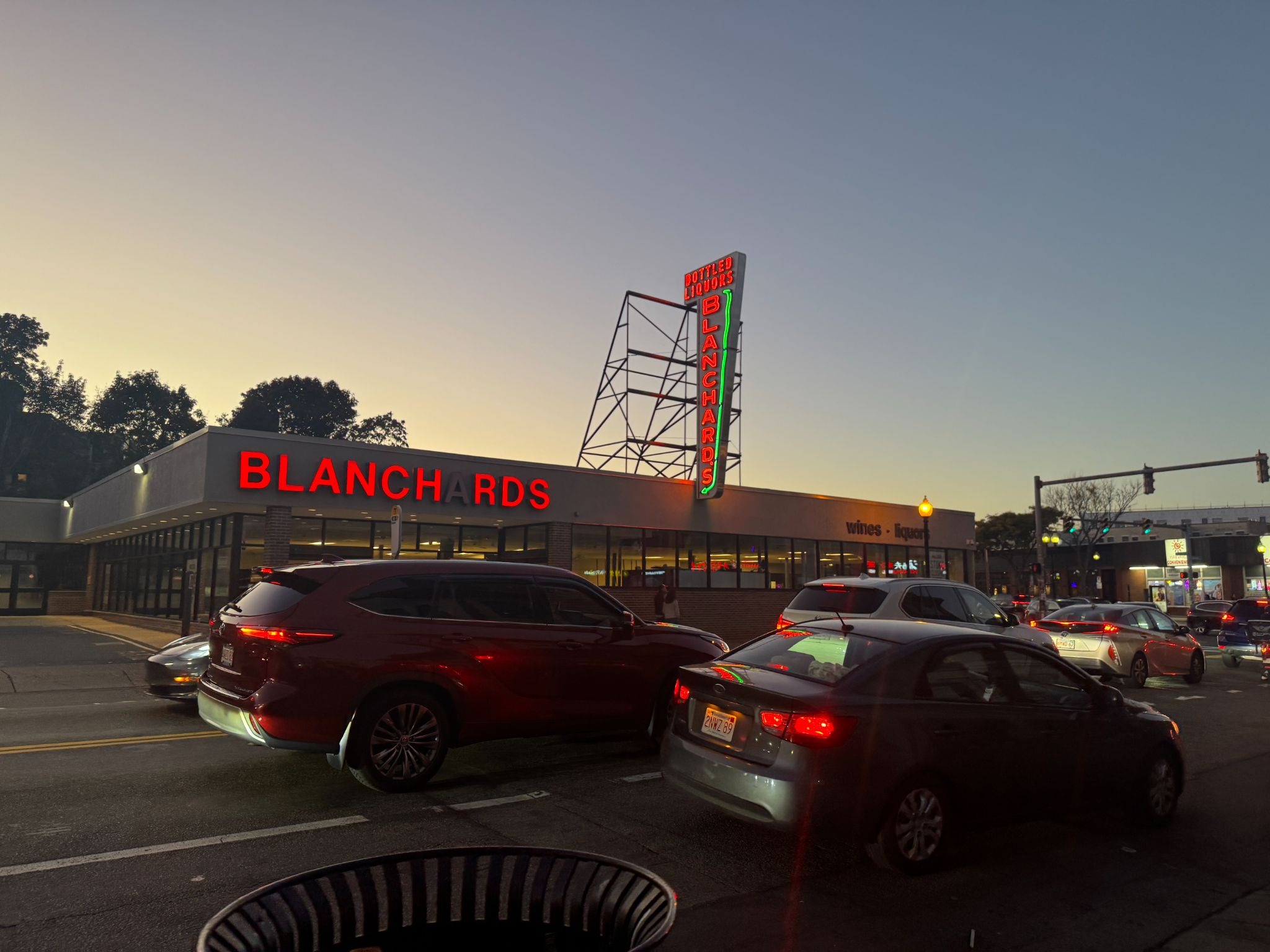
“It’s such a mainstay — that big Blanchard’s sign when you’re walking down Harvard Avenue — you’re like, that’s part of Allston,” Paige Schwartz, 22, a student at BU, said. “That was the first liquor store I’ve ever been in.”
Blanchard’s flagship store, an 8,000-square-foot space at 103 Harvard Ave., permanently closed Oct. 24. The storefront confirmed its closing in late September when an employee put up a sign, reading , “Fall 2026, Store Closing, All Inventory Discounted.” Blanchard’s has been operated by Chris Corey and his family for three generations.
The Allston location, one of seven in the Boston area, opened in 1954 and served the neighborhood for 72 years. It was among the region’s largest liquor stores, according to the company’s website.
The location was once stocked with more than 1,200 liquor products, 2,000 beer options and 1,500 wine labels.

Located near residential areas and BU’s campus, Blanchard’s developed a lasting impression among students and alumni.
“[Allston] really has its own identity, and Blanchard’s was kind of the focal point of that,” said Truman Dickerson, a recent Boston University graduate. “It was a locally owned business where the people would recognize you when you went in.”
A large neon sign that advertised their bottled liquors glowed over the streets of Allston every night, making Blanchard’s storefront a fixture in the community.

But beyond the storefront, students still recollect fond memories with the friendly staff and accessibility of Blanchard’s.
“You would walk in, and they’d always have someone promoting some kind of new drink or something right near the entrance,” Dickerson said. “Sometimes they’d give you free beers; I’ve gone in and gotten free baseball caps.”
While there are other liquor stores near Boston University’s campus, many students still found themselves gravitating toward Blanchard’s.
“Drinking is still a huge part of college social life, and Blanchard’s was probably the center within that area where you could actually buy stuff for a party or even for a more casual hangout,” Pike said. “It was very closely associated with the positive memories of spending time with people and being a young partier in Allston.”
The space is said to turn into a Teso Life — an Asian lifestyle and department store chain.
For the students and alumni that we spoke to, there’s a prevailing idea that the departure of Blanchard’s reflects a wider change in the storefronts of Allston.
“It kind of reflects this greater sentiment that, at least I know I’ve had since my junior or senior year, and that’s that Allston’s changing a lot,” Pike said. “It’s being updated, a lot of developments are going into new apartments, a lot of the more fun nightlife and unregulated stuff is being pushed out in exchange for real modernization.”
Blanchard’s is one of several longtime Allston businesses to close in recent years, joining Twin Donuts, The Draft Bar & Grille and Great Scott. Just this past August, multiple storefronts also closed their storefronts after decades on Harvard Avenue.
While the students and alumni appreciate the value that these changing businesses could bring to student life on campus, they acknowledge that the loss of Blanchard’s also means the loss of something that they saw was a staple to Allston’s identity.
“I would say the lasting effect, on at least me and I’d assume a lot of my peers of a similar age range, is it’s definitely sad to see something that seemed like such a big mainstay and identifier of the area to be transitioning away,”said Pike.
This story is part of a partnership between Allstonia and the Boston University Department of Journalism’s Newsroom program.