|
Getting your Trinity Audio player ready…
|
Founded out of an apartment in Allston, but now turning public libraries, church basements, and theatres into stages, Fork & Shoe Theatre Cooperative invokes cardboard and puppetry to scaffold together remarkably human productions like Destination Unknown with whimsy, grit, and artistry.
Fork & Shoe Theatre Cooperative turns the rigid confines of an elevator into a boundless space of exploration with its production of “Destination Unknown.” For the protagonist Alex, what starts as an elevator ride to DJ-ing morphs into a whirlwind of worlds as he grapples with identity and change within an elevator.
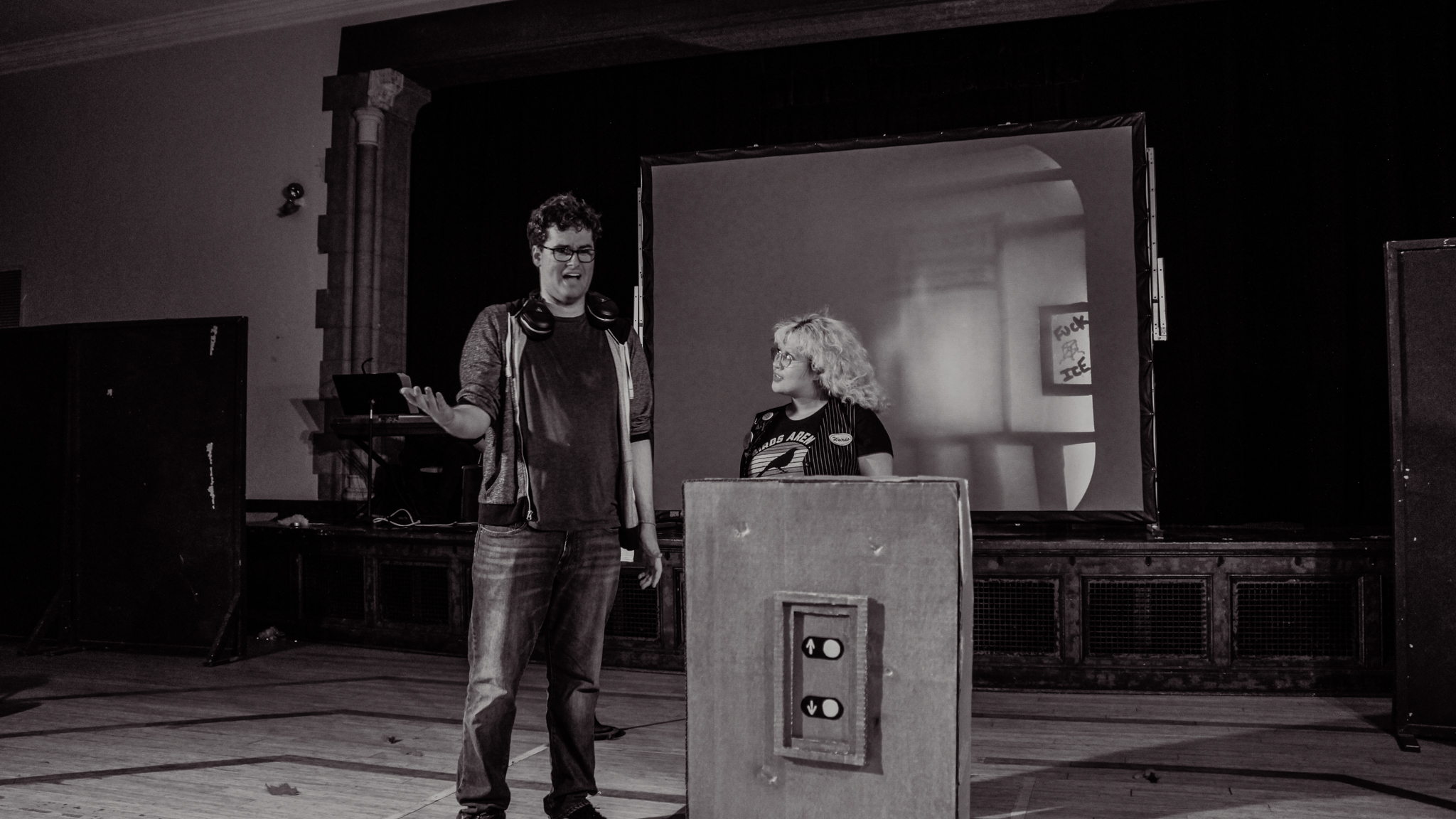
Within the basement of United Parish in Brookline during the last weekend of June, Fork & Shoe recreated the confined space of an elevator. The audience becomes a part of the setting as the foldable chairs form a tight U-shape around the box delineating the elevator with a cardboard box with numbered buttons.
The idea of “not knowing” permeates the parallel plots within Destination Unknown. In the span of 80 minutes, Alex is plopped in media res within alternative realities that change with a ding of the elevator. Masquerade dancers frolic around him. Secret agents warn him about “seagulls” (who are vampires disguised as birds). Superintelligent robots alternate between articulating sentences and monotonous beeping.
As if external uncertainty was not enough, Alex meets a parallel version of himself, “Lex”, who gives him a kiss revealing internal turmoil as he explores the question of his sexuality.
But in the end, true to its name, the resolution is that there is no definitive resolution. While many of the characters pass quickly through the elevator, the tempo of the play slows in one scene as one character walks up to a distraught Alex. They take his hands and tell him that it’s OK to not know before walking away.
Playwright Micah Pflaum, who lives in Allston, leans into different sources of inspiration that span across time and genre. He initially wrote Destination Unknown in an introductory playwriting course at Skidmore College in 2021. The inspiration for the play came partly from a daily elevator commute to the ninth floor of the apartment building where Pflaum was living for a semester.

In writing the play, Pflaum also says that he was heavily influenced by meme culture, particularly the “EEBY-DEEBY” Tumblr meme, seeing it as “a mysterious place that you take an elevator to get to, maybe not voluntarily.”
The play also takes inspiration from literary figures, particularly poetry. For instance, Pflaum, who says that he is “obsessed with poetry,” said that the imagery of an open garden was inspired by a poem titled “The Garden of Love” by William Blake.
“In the stage directions, where I’m laying that out, I describe it as a sandbox, but really the whole play, it’s this genre crossing, playful sort of thing. It’s both very silly and very earnest,” he says.
***
In many ways, Destination Unknown lends itself well into the experimental nature of the Fork & Shoe Theatre Cooperative. The group prides themselves as a “fringe theatre company” aimed at lowering the barriers for local playwrights and community members interested in theatre and production.
In their values statement, the theatre cooperative touts “cheap art” practices, popularized by the Bread & Puppet Theatre which conveyed that art should be cheap and available for everyone’s consumption. There is no cost to attend a Fork & Shoe production, but audiences have the option to donate.
Originally named after a house on Pratt Street in Allston where the three co-founders lived, the theatre cooperative later changed its name to “Fork & Shoe” after an anonymous vote on Google Form. Though the name had no deeper underlying meaning, members of the cooperative later found the name fitting to the values of the group.
“I always appreciate that the name is kind of two common objects that you can find anywhere, because that’s also kind of what we’re trying to do: make something out of what we have around us,” said Lara Brennan, who is part of the admin team on Fork & Shoe.

“You could make a really rad puppet show with just a fork and a shoe!” said Elise Brown, who helped shape the sound of the production.
Fork & Shoe took a similar approach toward producing Destination Unknown. For Lee Forrest, director of the play, one of the initial challenges was finding a way to convey the opening and closing of the elevator to the audience. They used a combination of an overhead projector bought from eBay and shadow puppets to display each of the floors.
A three-member band played music on stage using a combination of traditional instruments and more homemade ones. Brown told us that they borrowed a pair of wooden spoons from a neighbor to mimic the sound of dominos falling in one scene. They also showed us the thunder shaker used to make rattling or whooshing noises: an empty Chlorax can that was open on one end and a coil attached on the other end.
“A big part of Fork & Shoe’s musical brand sound aesthetic is using things like homemade instruments, everyday items, so I really love that,” says Brown. “One thing I love about Fork & Shoe, and one of the reasons why it’s my artistic home, is because it’s a space where I feel like I can play music, like play like a child plays with toys.”
Pflaum has also made a few adjustments to the play to fit the materials within Fork & Shoe’s inventory. Among them was setting one scene in the Green Line so that the production could use their homemade Green Line puppet.

“Sometimes it’s like cooking, like you have your recipe and you go through your pantry and you have most of it, and then some of that you’re improvising,” said Alison Weis, a member of Fork & Shoe who was helping work on the play .
***
Pflaum, who says that the throughlines in his plays are queerness and putting the impossible on stage, appreciates the whimsical nature within a Fork & Shoe production that affords him the opportunity to showcase his work.
“Theatres don’t have money right now, and the cheap art ethos lets us do a lot that a major theatre might think is not worth trying, like ‘if we can’t do it perfectly, we’re not going to do it at all,’” Pflaum says.
One of the co-founders of Fork & Shoe Nick Chieffo says that he hopes to connect more people with the idea of accessibility that underlie Fork & Shoe.
“Hopefully what we’re doing is modeling that creating work like this is possible. Despite the limited resources, or the red tape, if we can do it, anyone can,” said Nick.
“I think the antidote to the limited space and limited budget that exists in Boston and the US is resource sharing and getting more mutual aid and getting more people involved.”
Joanna Lin contributed reporting.