|
Getting your Trinity Audio player ready…
|
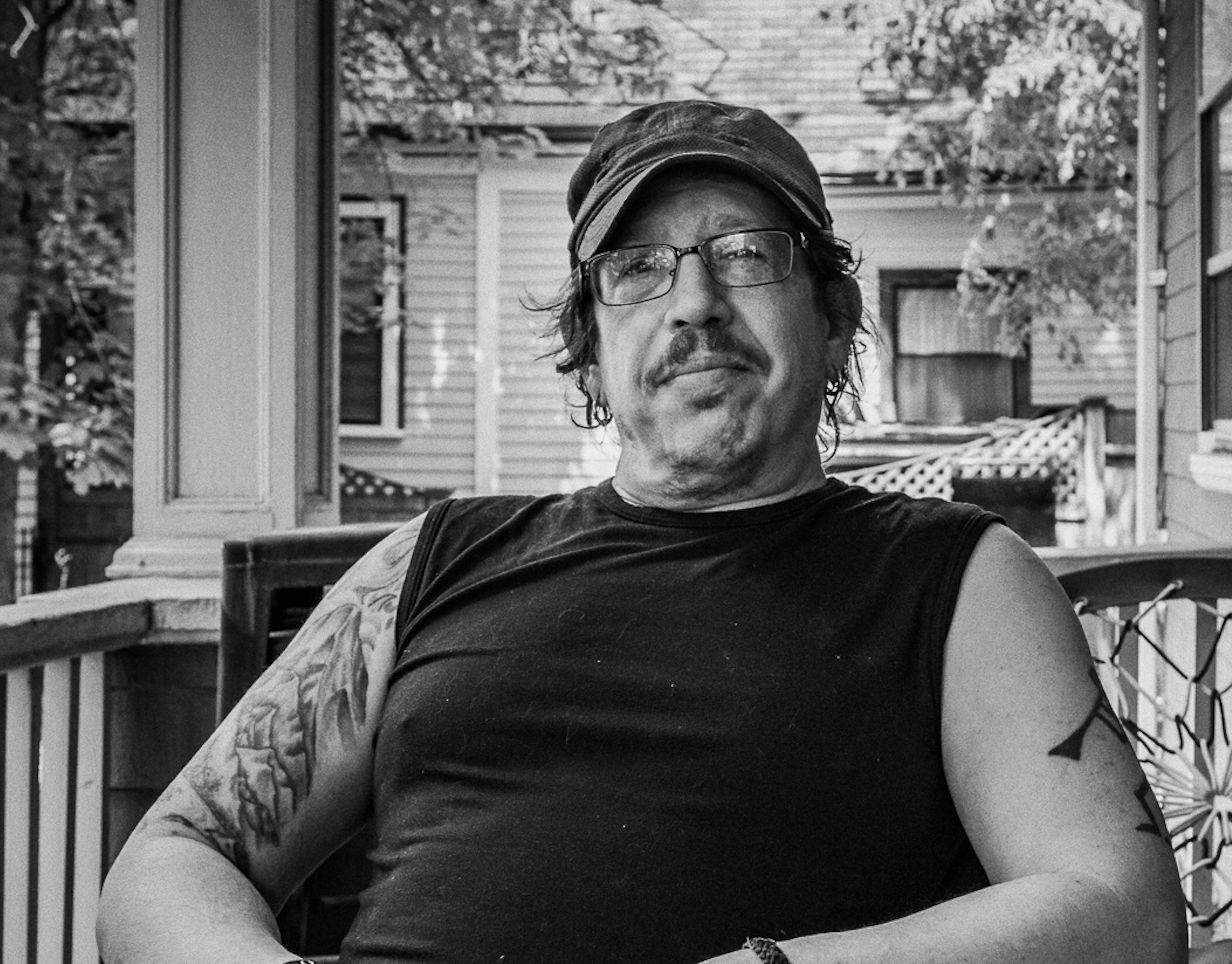
I meet Scott Matalon at @UNION (174 Harvard Ave). We only have until 3 P.M. before he’s off to archery practice. By the end of our conversation, he’s finished his fourth coffee. Probably since he’s a night owl, making live music or playing video games with others.
PART 1: THE BEGINNINGS
PART 2: GOING ON THE ‘NET
PART 3: STINGRAY TIMES
PART 4: COMING MARCH 15, 2026
PART 1: THE BEGINNINGS
How did your relationship to Allston begin? My relationship with Allston began like that scene fromWho Framed Roger Rabbit? where he goes to Toontown for the first time. I came with my friends because I’ve been living in East Boston and Huntington Avenue. I went to New England Conservatory (NEC). So I was living up at Mission Hill projects, we came down here, probably to buy pot. And we came down Cambridge Street, from the Mass Pike area, up and over the bridge.
And I was like, “Where the hell are we?” It was, like it was, and then all of a sudden, we turned onto Harvard Avenue and the sun came out and there were musicians and artists. So my friends and I moved into a big music house on Allston Street called Stumpworld.
When was this? Well, I got to Boston in ‘82 and I started playing on the blues and music scene. I discovered Allston earlier because of the clubs, Harper’s Ferry, Brighton Music Hall, Bunratty’s. But I moved to Allston in about ‘88.
Where did your relationship to music then begin? I was an artist. I lived with my grandfather, who was an illustrator, and my grandmother and my mother. With some family tragedy, I had to live with my mother’s family. They were all artists, sculptors, and all. My uncle was an artist.
And in fourth grade, a guy showed up and said, “Anybody who wants to be in band, follow me.” And I just got up and followed him. They started me on tuba. And then when I was older, I started playing trombone. I did all the All-Counties and All-States. I discovered rock-and-roll, at 14, 15, years old, my brother and I. KISS and Blondie and Led Zeppelin and Ozzie and Sabbath and Pink Floyd and oh, my God.
And all I wanted to do was make the kind of music that I listened to.
I had no idea how to do that. My band teacher in high school introduced me to the idea that I could go to school for music. I had never imagined such a thing. My dad wanted me to get a normal degree. So we compromised, and I did the dual-degree program when it was just starting with Tufts and New England Conservatory, but the train line ended in Harvard Square, so it took forever to commute. I got to about three years of it, and I dropped it.
So where was home before Allston? I grew up in New York. I had an apartment in Eastie. Then lived on Mission Hill. As a college student, I lived in a series of shitholes, first dorms, and then, you know, crappy apartments with friends.
What were you doing in Allston? As a musician at school, they encourage us to play out, to play clubs, to play on the streets. Being interested in rock, I was playing on the street with Vietnam vets that were in their like thirties. When I was 18, I used to play with Little Joe Cook. I got involved with the blues, the blues people. So I started playing at Harper’s Ferry a lot. I started playing Bunratty’s.
What was that era of music in Allston like? Very analog world, but we would busk on the streets. We play all the local clubs. We call, you know, book our shows and promote them via mail. Because it’s Boston, every spring, by the end of the summer, all our mail will be returned. The kids come back, and the students come back, and we would get a lot of mail kicked back, and we peel them off our mailing list and print out a new one, and find new people.

What were the hours like when you were a young person? Have those changed over time? No, I still go to bed at 4 A.M. in the morning, playing video games at 3 A.M. or I’m in the studio.
What was the ratio of time you spent playing in these sorts of rehearsal spaces in Boston versus at NEC? I probably got half my education on the streets and in the club, easily.
NEC was great. It was an amazing musical education. It was eye opening. But I was in the jazz department. It’s a conservatory, and as much as they push you, you get out and you’re playing rock-and-roll with Vietnam vets at the Harvard COOP, you’re being influenced by people who just study the blues and play the blues and things. You don’t get that in school.
We were playing on the street with stinky people, street musicians, and alcoholics. I’d play with a guy from New Orleans who had a Dunkin’ Donuts cup at six in the morning full of bourbon. Then, I’d go to class, and I’d come back and meet my other buddies, and then play rock-and-roll at Park Street or Harvard Square, you know.
So you’d meet all these amazing people and just play. And they’d be like, “Hey, let’s play. Let’s play!” I met this young guy who was a guitar player. He was my age, in Harvard Square. I needed someone to play with. I was like, “Hey, play with me.” And then I ended up in a band with him. We opened up for Huey Lewis and the News on “The Heart of Rock-and-Roll” tour. We played in New York. We played all over. We were a big band for the time. We were a 12 piece R-n-B band.
You never know when you meet someone like that, what it’s going to turn into. We’re still lifelong friends, me and the brothers.
In your twenties, living in Allston and meeting so many different kinds of people and making music with them, what did you learn about life? It’s love and heartache and breakups, and you know, “I love you,” and “Why are you doing this to me?” and like going through all the same things that everyone goes through, stress and betrayal and relationships.
You’re away from your parents, your families, hopefully for the first time. I think it’s an important experience. People should get away from their families when they’re 18 and move away from home when they grow up.

When you’re surrounded by your high school friends and your family and your parents, you behave a certain way. When you start getting out on your own, you start developing as a musician or an artist.
You know the Elton John movie — his friends say to him, “You have to kill the person you are to become the person you want to become.” Distance makes a difference. You can explore aspects of your personality and your art that you would have never done if you stayed with the people, all their expectations that were on you.
I never realized how self conscious we are. Getting away from it, coming to a city far enough away, surrounding yourself with everyone, from Vietnam vets busking around the street to other people and bands or going to play with people of all ages and shapes and sizes and colors and nationalities. You play Turkish music and drum on the streets. And there’s no substitute for that. Get away from your fucking family, get out there and become who you want to be. You have to kill the person you were to become the person you want to be. It’s true.
PART 2: GOING ON THE ‘NET
Did you ever have thoughts about leaving Allston in your twenties? Yeah, I never expected to stay here. This was a chance to go to music school and learn and be in a city and learn to play the music that I listen to. That’s really, I mean, though I was a jazz major, I didn’t listen to jazz. I listened to Led Zeppelin and Pink Floyd and Nirvana when Nirvana came out.
I was doing everything I could to get signed. We were sending out demo tapes and CDs from every band that I was ever at this age.
So what made you stay in Allston in your twenties? Ah, it’s the best damn neighborhood in Boston, the art, the music, the food, the scientists, the technology, the cross pollination of everything is here in Allston. It’s all in Allston, it’s true.
Dorchester wasn’t having its Renaissance then. Chinatown was just restaurants. Boston was a very different place in the eighties, the combat zone was a scary place, but it was nothing compared to New York. But, when I got here my first night in my dorm, there was a race riot on Huntington Avenue between a huge two, huge crowds of people. It was awful. Northeastern was half its size. The projects on Mission Hill were awful. They’ve been redone a couple times.
Boston was very, very — much more dangerous and different place. Allston was like the village, the place where all the artists, all the musicians, it was affordable, and people lived here that were artists and musicians their whole lives. They would stay here after college, and they would live here. I’m one of the last few who still can afford to do that. Most of them have moved.
What was it like being a software engineer in the ‘80s and ‘90s? Back in the ‘80s, being a computer programmer, or a person having anything to do with computers, was a great job, because nobody knew what you were doing and nobody pretended to know what you did. There weren’t a million people with Microsoft certifications running around.
I had started programming software with accountants for small businesses around ‘84 in basic PCs with floppy disks, they weren’t even hard drives, and that I ended up becoming the MIS (management information system) director at a place called Boston Biomedical. They did market research. So they would study companies and how companies are testing products for humans. I didn’t care about any of that, but I wrote their software, and it paid for my music. It paid for me to buy amps. I was able to have a flexible schedule. I had long hair. The computer room was the only room you could smoke in.
A lot of the musicians were either — you worked in restaurants and food service and bars, or you worked in computers. There’s a real simpatico between musicians and working from computers. We work well in small groups. We thrive under pressure. It’s a conceptual thing. It often takes improvisation, you know?
And it wasn’t the industry that it is today. A computer store was a filthy, little, tiny place that had a little bit of hardware and one rack of software, like Word Perfect and PFS (Personal Filing System) right, and Excel — it wasn’t even Excel — it was Lotus 1-2-3, you know? I mean, there was no Windows. We were using BASIC (Beginner’s All-purpose Symbolic Instruction Code) and it was this great job. And then when the military got their upgrade, their network got upgraded in 1988 to the first fiber network. They got the Milnet, and its secure network right for contractors and research labs and the old network got declassified.
Paul Bernick Newman and DARPA, the Defense Advanced Research Projects Agency, put together the pilot group for the commercialization of the internet. They were originally connecting the schools together, MIT Lincoln Labs, Harvard, and they were giving the computer science majors more and more access, and Microsoft and AI Corp and all these companies in this office park in Waltham where I worked, they wanted access, and they let us be the pilot crew.
So when the web came out, we were the only civilians that knew this technology, we understood how it worked, so that’s how we very quickly started getting a lot of work.
What was the software you were creating for the music industry? We wrote the operating system for the most powerful agencies. We wrote the operating system for Artistdirect and then CAA (Creative Artists Agency), which is the most powerful company in Hollywood. So it booked and managed all the world tours for everyone from Madonna to Pearl Jam, Soundgarden, the [Red Hot] Chili Peppers, Rage Against the Machine.
I mean, the biggest bands in the world used our software to book and manage their entire world tours.
And then we wrote worldwide market share analysis systems for EMI [Records], and we did all the frontend e-commerce for the Stones and all the bands. We published the number one e-commerce software in America. It was called onlinemerchant.com.

We published it at Staples, CompUSA, and Best Buy because you didn’t buy software online boxes at stores. Then we built a mall. It was Amazon before Amazon, Amazon was selling books, they were just getting into electronics. And we had a mall with hundreds and then thousands of merchants. It was an online mall. It was the first online mall. We had patents on shopping carts and digital coupons, and we built the company up to 80 people.
We started it at 48 Allston Street with two friends, and became 80 people and two offices. We raised about eight million dollars of venture capital. We got bought by a public company for about 80 million dollars and then we became part of a company. We were 400 people in five offices in four countries. We were processing three million dollars of credit card transactions a day. We were doing a billion dollars a year credit card transaction, but they bought us. So they merged us into that. Only a couple of us really survived the transition. I became the Chief Information Officer.
We became the shopping channel for Canada, AOL Canada and the Royal Bank of Canada. And I had millions of dollars. I was rich on paper, it was all stock. And then I left the company. There was 9/11, the Bush recession, stock market bubble burst, and it all went away. Our stock went from 20 dollars to 20 cents, and I had to sell everything, and that’s when I started Stingray [Body Art].
Our mall was called buyitonline.com, and we were StumpWorld Systems, and it was kind of like a big middle finger to the old guard. I mean, bands like Steven Tyler and Aerosmith, they loved our name. But then we would walk into Ninex or Continental or Stone and Webster, and they’d be like these long hairs say they know how to fix our stuff, and then we were their long hairs, I’m sure there were many a party that were like, “You won’t believe this company.”

Where do you think that this spirit of being a creative disrupter comes from for you? I think I was born with it. My brother calls it The No Fear gene. I started selling drawings on the street when I was five. My brother and I were mowing lawns for money at 13, and then I bought a clam boat, my buddy and I, we were clamming, and then I managed my first restaurant at 15.
But all I wanted to do was be famous.
So everything was a means to an end. Everything — going to music school was just a means to an end. Like, “how do I get famous?” On the street, find rock-and-rollers and learn how to play this music. And it was totally single-focused ambition, and that’s why once we started playing, you know, even our R&B band, we were booking tours and playing shows, and we opened for Huey Lewis on The Heart of Rock-and-Roll tour. Lewis on the tour with Tower of Power, with thousands of people. All we wanted to do was get signed. That was it.
Somehow this internet thing just magically happened, and it took over.
And instead of becoming like rockstars, we became like internet rockstars, if you know what I mean.
And we were working for the Beastie Boys and the Chili Peppers and the agencies and the record companies. They didn’t care about our band. They didn’t want to hear about our band. They want to know if we could do a new venture and sell whatever thing they were doing but bands didn’t sell merchandise online back then — KISS was always like that, but, you know, bands didn’t sell stuff directly. The record companies would sell licensed shit to Toys”R”Us, like lunchboxes and t-shirts, but we did a website through the agency for Rolling Stones in about ‘97 and they we put up about 300 products for adults, and everyone was freaking out that they were selling out, because that’s what it was considered.

It was horrifying to the industry, but it sold a million dollars of products in 90 days. And it changed the music industry. Everybody started doing e-commerce after that, because the only thing bands sold was the stuff. When they were on tour, t-shirts and programs, and then their fan clubs would sell the old stuff from the old tours. And some lithographs and stuff like that. And by the nature of e-commerce, the bands could sell it directly, and they could keep the bulk of the money. The record companies would license Pink Floyd t-shirts. You buy a Pink Floyd t-shirt at Target. It. You know, the record company is making a lot of money, and the band’s making a penny, but when you buy the Pink Floyd t-shirt off of the Pink Floyd official website, the band’s making the money. There is a very big difference there. So it was very, very empowering.
Were you satisfied getting fame as an Internet entrepreneur, getting fame from the inside instead of as a musician from the outside? It was amazing walking in, you could walk into a room and everybody would shut up and listen to you. Nobody knew how to do what we were doing. And there were new discoveries and new ways of doing stuff every day. That was amazing, but it was very frustrating also to be so close and I’d be like, “Come on.” I worked with agents, and I’d be like, “Just give me an opening slot. Just just for fun.”
Nobody in the music business wants to hear you know, “I’ve got a band. My friend’s got a band. My kid’s got a band.” They don’t want to know that. They want to know I had a thousand, I had a million streams on YouTube. That’s all they want to know. They don’t want to know that stuff. So there was a frustrating factor.
But it’s pretty amazing to sit in a room and have a conversation with Steven Tyler and Joe Perry, who were like the nicest guys — the whole band. And these guys were the soundtracks to our teenage years, and here we are discussing their Rock-and-Roll Hall of Fame exhibit, or, you know, how they could do something more on the internet. They didn’t have MailChimp, Those things didn’t exist. We wrote mail guns — people could sign up to a mailing list, and the band could mail their fans. That was a huge development. We had calendar software. We would write this stuff in Perl script [the programming language]. We were inventing these things that are for the bands, and then we would use them for ourselves, and we would change the interface and use them for our corporate clients. Aerosmith’s mailing list is no different functionally than Stone and Webster’s investor relations communications tool, right? So, these things were universal. Now they’re commodities. At the time we would hand make these, we watched the world change and change the ways we never thought possible.
PART 3: STINGRAY TIMES
How old were you when you started Stingray? My company got bought in 2000, 2001 that’s before the stock market crashed. I was a full grown adult. I was covered in non-competes because I hadn’t been bought by this other company, and I wasn’t allowed to compete against them because I had sold my company to them. I couldn’t do e-commerce, plus I was rich. I had 20 million dollars in stock personally, and I started making movies with my friends. Then when the stock market crashed and everything was wiped out, I lost $18 million over a weekend literally.
I sold my house, and I sold part of my recording studio, my big amps. I sold my Stingray Corvette (I had a ‘64 Corvette Stingray — that was the year I was born.). We opened Stingray tattoo because at the time, it was the sixth fastest growing industry in America, and I would get to work with artists and I’d be in the happiness business.
It was a way to start over. I had to start over. I lost all my money. It was all gone. One minute I was looking at what island I was going to buy. I mean, I was crazy. The next minute, we were scrambling to open a business. And it was the early days of tattooing, and it was hard at first, but we became the highest grossing tattoo shop in New England.
What were the early days of running Stingray like? Was it easy to recruit artists and find people? Well, not really. [In] the tattoo industry, there are no schools, so it’s an apprenticeship system. It’s very much built on trust and word of mouth. We started it with two artists, and it took a little while to start attracting talent. Then we attracted some amazing talent and our home grown talent. Some of the best artists we had were people that apprenticed through us. A guy named Josh Chico Torres, he’s one of the most amazingly talented tattoo artists I know, and he was an apprentice. And Nate Stevens and Matt Park. We grew a lot of our own talent. We became family, and [it] was a very, very close knit place.
But no, it wasn’t easy. And at first, a lot of the industry hated us because tattoo shops were going from the back streets to main streets. There was that time where they were the sixth fastest growing industry in America. They were right behind bagels and cell phones. And a lot of people didn’t like that. And we were making a showroom of a place on this big corner. On the message boards and other tattoo artists were screaming at us: “Oh, you’re gonna see the ruin of everything. “It was just like when the Rolling Stones started selling merchandise themselves. Everyone was like, “Oh, my God, you’re selling out. You’re gonna ruin everything.” But it didn’t, and now they’re all doing it. Everyone’s on Facebook. They’re all posting their pictures on Instagram. They’re all advertising. People want selection and service and guarantees. Consumers want to go to a place where they can trust that they’re going to get this plumber to work on their body.
Was there a certain decision-making process to open it in Allston versus any other place in Boston? We looked at some places in Boston. We looked at Downtown Crossing, and that space became available. The guy who owned O’Brien’s and Great Scott — his name was Frank — had been a tenant of the people who owned that corner [Harvard Avenue and Cambridge Street], and they had it as an antique shop. Then he bought it from them, and the plan was to pass it on to me, and I would buy O’Brien’s, and then I would own it. But then all the development began, and it became a development instead, but the idea was to pass the torch, but the building became available, it was right there on the corner. How many cars go past the corner at Cambridge and Harvard Ave? It was a perfect location. And everything in retail is location — it’s the most important thing. So location was key to it. Downtown Crossing and Newbury Street just seemed a little bit out of the way. We started looking out into the suburbs for other locations, but that was really the right spot, and it really was.
When did you start Sting Ray in the early 2000s? 2005 we opened. It took about a year and a half to get open but we opened in August 2005 and closed in August of 2023.
Was it a hard decision to end it? It was awful. We tried everything we could. But between the social distancing, the medical supplies and everything that we used, the gloves, the bandages, the guys. We used to pay 6 dollars for a box of gloves. They were buying them on eBay for 40 dollars or 50 dollars a box and a tattoo artist. On a busy day, I’ll go through three boxes of gloves, and getting the stuff was impossible. And then, without the social distancing, people weren’t coming in groups, and a number of customers just fell as a result.
Everything changed. The whole industry changed, and we tried everything we could to streamline our process to let people book their own appointments and their own consultations. We put everything online. We couldn’t keep up with that rate of change. All the tattoo shops that you see now, for the most part, they’re very small. They’re amazing, but they’re small shops where the owner is tattooing along with a couple of other people.
We were a huge showroom operation, and we just couldn’t make the transition, and we couldn’t scale back during the shutdown. We still had to pay our rent, we still had to pay our insurance, the prices didn’t go down, you know? So it was just awful.
What are the stories from Stingray that made you feel “Wow. Running this business was very fulfilling.”? It was an amazing business. It was probably one of the greatest businesses in the world. People come into a tattoo shop, they want to get something permanent on their body. Especially for the first timers, they’re nervous; they’re scared. These tattoos always have meaning, and part of it is self empowerment. They’re memorializing someone they lost, or they’re getting a picture of their children, or it’s a word that means something to them. I think especially among young people, they’re taking control of their body. It’s that same thing about getting away from your parents. I put this tattoo on me. I’m claiming my body. This is mine. It’s my tattoo on my body. I’m in charge of it. I think there’s a ritual that people don’t talk about enough that it’s an ownership thing.
We would work a lot with domestic abuse survivors. We did whole programs with them, and they would bring us these women that were a bit abused, they would have the name of some guy that had been forced onto them. We would cover it up, returning something beautiful. Or the women who had had, you know, breast cancer and stuff, and after they healed, we would do tattoos and make them feel beautiful. It was so unbelievably empowering. We would tattoo people, and they’d be crying. You were instantly their pal. And then they’d come back and they’d be like, “This is my guy. This is my girl. This is my tattoo artist.” We’d have these amazing relationships with our customers.
You know, you always go to the same dentist, but you don’t necessarily love what he’s doing here. But once you go to a tattoo artist, they’re your person, there’s a trust factor. They are such a personal, painful thing, and they’re putting something permanent on you. It’s an amazing thing.
What’s a tattoo that you have that is extremely meaningful? All my tattoos have meaning. I’ve got a samurai on my back that epitomized my life for a while. He’s on his horse. Arrows are flying at him. They’re stuck in him. He’s fighting his way. He’s just under assault from every side, and he’s just still moving on. That’s an important tattoo, you know?
I’ve got memorials. The three of hearts from the tower deck with the three swords going through the heart — I lost a number of friends when I was young, all at once, and I was sort of left in Boston by myself. Two of my friends passed away tragically, and one of them moved very to the other side of the earth. And so that’s a very important tattoo.
Every tattoo has some meaning. I had a cat that I love more than anything. He had a little dog bone collar; I got that tattooed on me. I have a lot of small tattoos on me, but that’s the thing. Everybody’s tattoos have some kind of meaning.
I’ve noticed that you are a risk taker, and I’m curious where this comes from in a world where it’s really easy to take a certain mainstream route? Do you have advice for people who aren’t willing to jump into the alternatives to life? It helps to know where what you want, and to be ambitious and to not be afraid to try stuff.
I was a horn player playing here in the back, and I was so jealous of the guitar players and the singers that I started to learn to play guitar and sing.
And then, when I got to Allston, I stepped up front and started singing. As I was writing songs for the band, I was learning to play guitar. Then eventually I started playing guitar and put down the trombone and just it was. My high school self wouldn’t believe that I could sing and play guitar and stand up in front of a band. It was an inconceivable thought. I had no idea how to get there, so I had to go somehow to do it.
For young people like it doesn’t matter where you come from. It doesn’t matter what your background is. It doesn’t matter. I mean, of course, these things affect you and they matter, but you have to just step out of it. You have to the most important thing, and I always taught this by Pamela Burton, who’s my business partner, most important thing in life, the thing that affects 99% of the great and terrible things that are going to happen to you — barring family stuff and sickness or whatever — is a direct result of the people you choose to surround yourself with.
So you want to be a musician playing out in clubs. Go hang out with musicians who play in clubs, and no matter how terrible you are, go do that. You want to be you want to make movies. I don’t care what you have to do if you have to run around and get coffee until they let you hold a microphone or a camera. That’s what you do. Just go. Get away from the people who think they know you, and go do what you want to do.
You have to put yourself there. You have to get off your ass, you have to be fearless, and you have to do it. But go find people who are doing what you want to do, and surround yourself with them. You hang around with your knucklehead friends. You’re only going to end up in knucklehead situations. You hang around with smart people doing cool things. Pretty soon, they’re going to hand you a camera and say, “Can you do this?” And next thing you know, that’s what you’re doing.
Do you think the neighborhood of Allston helped you to surround yourself with the people you wanted to? It did, and my great fear for Allston is that they’re pricing out the young people who do those things. It’s great that there’s a lot of college students that live here. They get a lot of stuff done, but it’s not the same as people whose sole ambition is to create art or create music or start a company, be entrepreneurial, to invent something and get it to market. You know students, they got grades, they got classes, and maybe they do stuff on the side, but the neighborhood has to be there for them. When they get to their third fourth year, they’re doing their own projects, and then, they’re not going home for the summer, and they’re starting something with their buddies and their friends, and they’re going to start a company, and they’re going to start a band, or they’re going to set up an art gallery. There’s no more art galleries. There’s no more clubs. (Okay, there’s one club here, O’Brien’s). That’s it.
There used to be a whole ecosystem of people who represented artists, you know. Now, everyone’s like “Oh, you’re an artist. Saw your stuff online.” What about the galleries? They’re gone. They’re gone. There’s the Out of the Blue Gallery, and they have been picked like a dog from one end of Boston to Somerville to Cambridge. They’re just still trying to survive. Part of what I’m doing in civics is trying to introduce the words “affordable retail.” Because you can have affordable housing, you can make some artist space, but the fact is you have to be able to conduct business. What are they gonna do if these clubs close? Is the city gonna do a non profit punk rock club? That doesn’t make any sense. It has to be a business, so people have to be motivated.
There’s no replacement for that, because harnessing the power of motivated self-interest is the economic engine of America. People start a restaurant because they love to cook, or they love this type of food they want to bring to the world. They have to be motivated, and they want to make a living doing it. So Allston, the scariest part right now is just the pricing increases the cost of development. It’s just a natural thing that happens, but it’s sad to see.
What’s your advice for the young people who are living in Allston — particularly the artists — and feel like they don’t have the infrastructure to support their dreams? Us old dudes, you know, we look back on things. Everything was rosy, back then, infrastructure exists. There are people doing stuff. There’s organizations, whether it’s main streets or artist asylums, there’s rehearsal spaces — you know Studio 52. There are clubs. You can go to O’Brien’s a dozen times, and you will meet musicians and people and bands and people that want to play and people that want to start other bands or just want to jam. You want to be in film. There are people; don’t think that there aren’t. Put up flyers. Go to Mr. Music. Get on to the message boards and the Facebook groups — free stuff in Allston and what’s happening in Allston.
There’s just a different way of finding it, but don’t take no for an answer. Go find it, track it down. You’re gonna find them here in Allston.
And you got to go to the clubs, you got to go to where these things are happening.
This interview has been edited for clarity.