This year marks 10 years since the Boston Fencing Club made its move from Waltham to Brighton. In that time, from fencing in the park to combining fencing with STEM mentorship for local students, the oldest fencing club in the country is opening new opportunities to make fencing accessible to Allston-Brighton and beyond.
“A lot of people refer to fencing as physical chess because it is almost equally mental and tactical as it is physical and technical,” said 31-year-old Nina Sayles, the club’s director of community engagement and development, a long-time fencer and an Allston-Brighton resident. “Somebody who doesn’t necessarily fit the box of an athlete can find a lot of success in fencing.”
Boston Fencing Club, is a nonprofit organization that offers classes, camps, and clinics for anyone interested in the sport. The club offers scholarships and financial assistance, whether that includes finding a competition waiver or other external scholarships, so that athletes can participate regardless of their financial situations. They are also all about providing opportunities for younger and older generations despite physical setbacks, and BFC trains fencers who go on to compete nationally and internationally.
“Our mission is simply to be able to offer opportunities to pursue this board of fencing to anybody in the Greater Boston area, regardless of potential financial or physical barriers,” said Sayles, who has been fencing at BFC since 2017 and has represented Team USA on the world cup circuit.
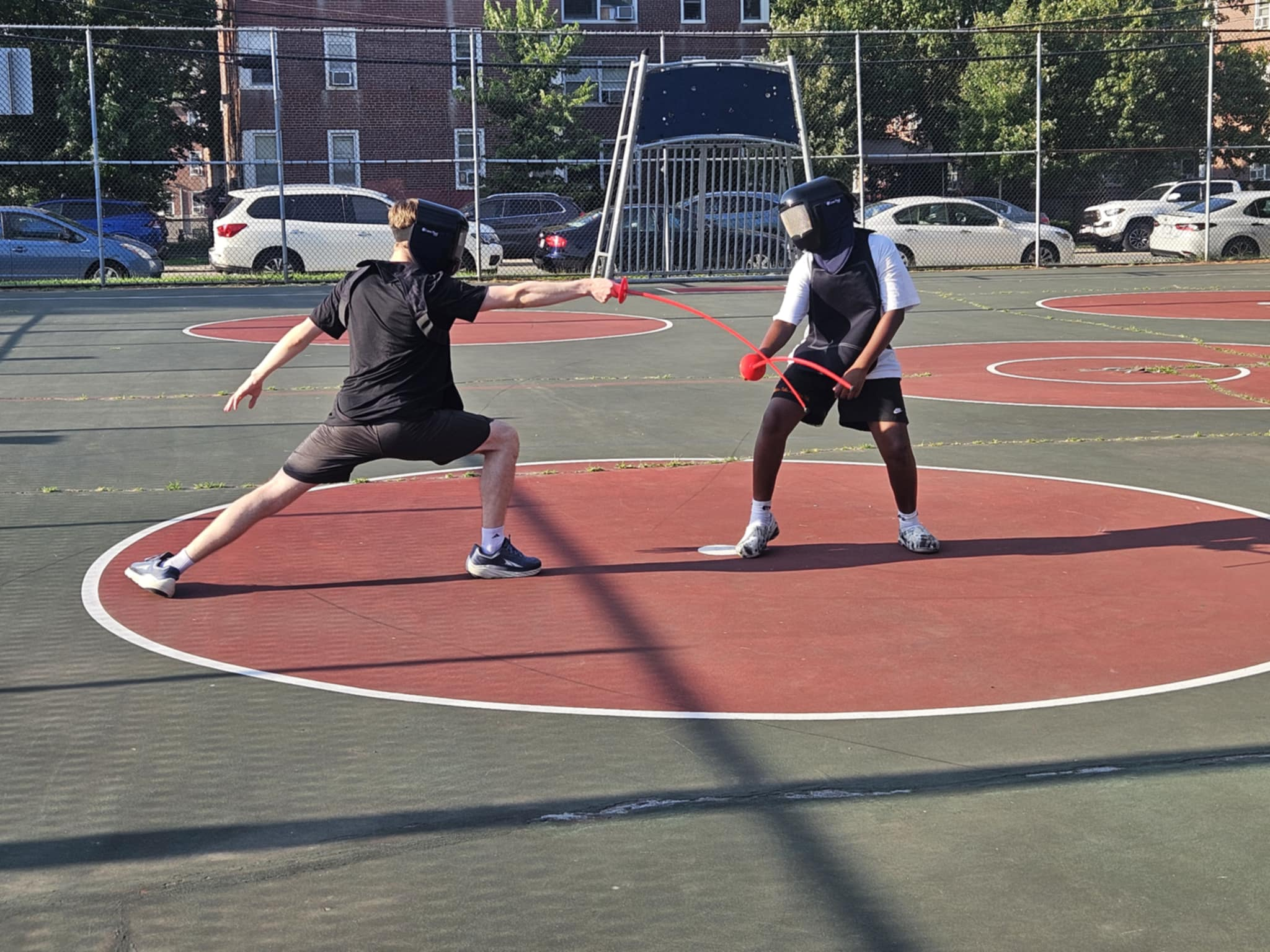
To that end, BFC has hosted community-based programs that invite Allston-Brighton neighbors to try out fencing for free. In 2025, BFC partnered with Friends of McKinney Park on a collaborative program called Fencing in the Park, a free opportunity for kids in the community to get outside and try fencing in a “lightweight, non-intimidating way,” as Sayles put it.
“The more that the park is activated, the better, and it seemed like it was low lift because you don’t need a lot of equipment.” said Pam Mullaney, the co-founder and treasurer of Friends of McKinney Park. “I just had faith in Nina that it was going to be a meaningful and consistent experience and low cost, which is a big value for Friends of McKinney Park.
“We thought this would be a great thing for kids who maybe don’t always have access either to transportation to get to activities in the summer or don’t have 200 to 500 dollars to spend to get out and learn something new, and it seemed to go very well.”

Another program initiated this past summer was STEM on Strip, which a nationwide, youth-led nonprofit called Fencers DoGood pitched to BFC. The program aimed to bring in middle schoolers from Allston Brighton for free fencing coaching and STEM lessons from high school volunteers.
“I wanted to give back to the community because I remember having so many great mentors myself,” said 14-year-old Adam Khanna. “I remember one kid, we did a marble project, and it was super advanced and he was only in fourth grade.”
Khanna is among one of the many successful fencers from the club who have competed internationally. He just made his junior world cup debut in Germany while representing his parents’ native, Australia.

By Alyson Yam.
Outside of its community-based programming, BFC has also sought to reduce the physician, financial and age barriers that could be linked to fencing. The club offers scholarships and financial assistance, whether that includes finding a competition waiver or other external scholarships, so that athletes can participate regardless of their financial situations. Through donations, they are also able to provide equipment that fencers can borrow or purchase for a discounted price.
Salyes, who has been fencing at BFC since 2017 and now competes internationally for Team USA on the world cup circuit, says that the club’s strong coaching helps athletes from children to adults train to higher levels.

“Historically, we’ve had handfuls of world team members in all age groups, from the under 17 category to the regular senior world team, and then even veterans – which is, in fencing, the word for masters or older ages.” she said. “We’ve created a much stronger adult network than I think you can find in a lot of places, so when I started training here, that’s kind of what I was doing it for, just being part of the community.”

Sayles also said that BFC also has a “very active parafencing program,” the paralympic equivalent to fencing. Additionally, their parafencing program gives fencers, who use wheelchairs, access to proper and specialized equipment and professional coaching.
“The wheelchairs are kind of a specific chair that locks into a frame so that it’s safe for the athletes, since you’re only using your upper body and there’s some distance created by leaning backwards and lunging forward,” Sayles explained. “There’s actually a lot of strength and movement in this, so we have to be really locked down and solid.”
With ten years at its Brighton location under its belt, BFC is still looking to grow its presence in the Allston Brighton community and attract young athletes who are interested in the fencing sport.
“Fencing is a really unique sport that attracts students who aren’t traditionally interested in sports,” Sayles said. “I hope that we continue to produce the successful competitive athletes that we do while expanding our reach at the grassroots level, and particularly within the community.”
This story is part of a partnership between Allstonia and the Boston University Department of Journalism’s Newsroom program.