|
Getting your Trinity Audio player ready…
|
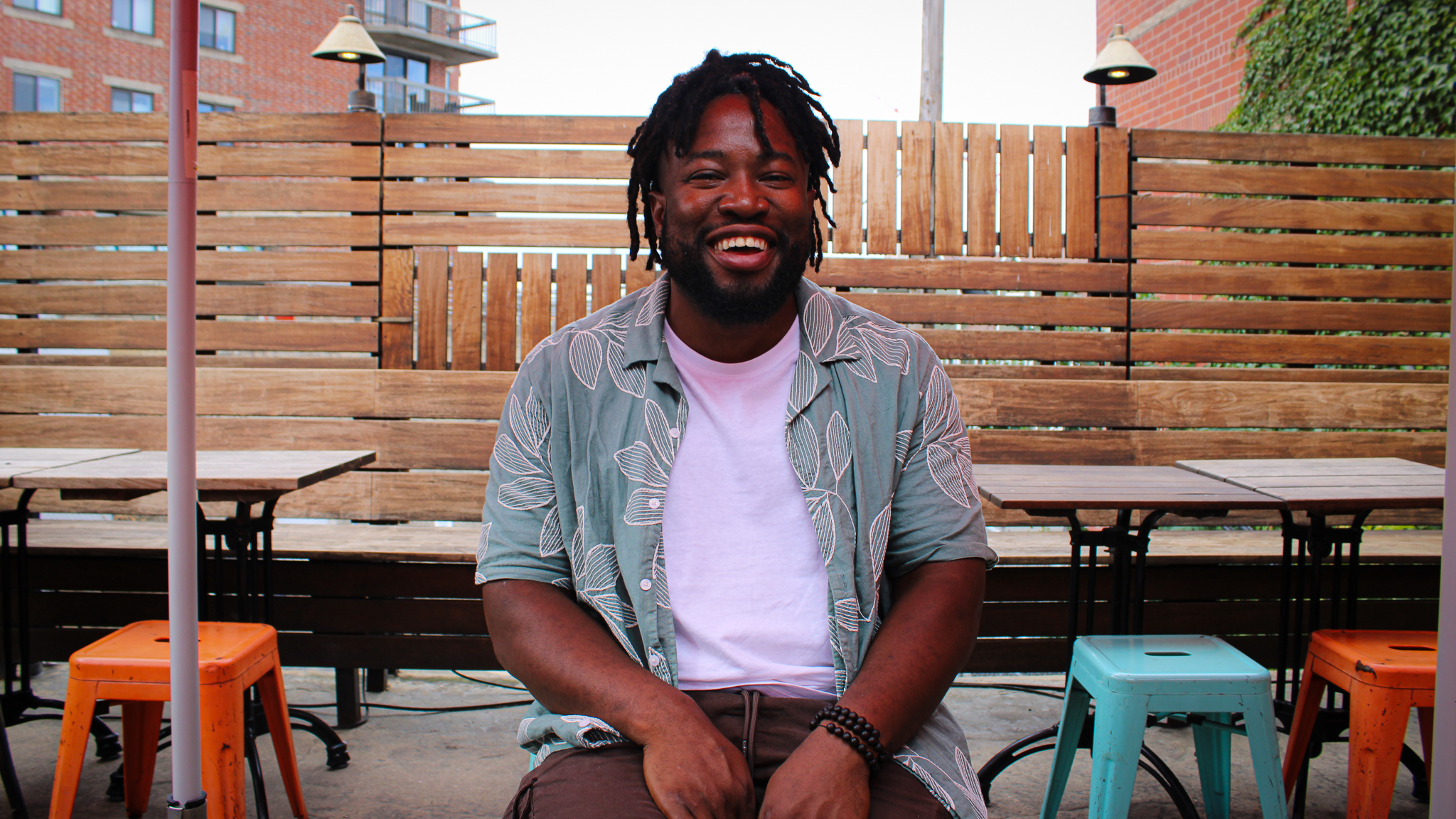
Inside Lone Star Taco Bar I am drawn to the back patio, which reminds me of the backyard patios of my childhood years living in rural Missouri. There, I meet the newest Allston Village Main Streets executive director Steve Marcelin.
When did you first come to know about Allston, and how did your relationship to the neighborhood begin?
I knew about Allston when I was in college. I feel like it’s a rite of passage. If you go to college in Boston, you will discover Allston.
I spent my first year at Wentworth. Then I transferred to Boston Architectural College. At some point, I took a break and went to North Bennet Street School. I completed a program there.
Boston Architectural College is one of those colleges that doesn’t have a dorm, so all the students live all over. It was a commuter school at the time, and a lot of my fellow architecture majors were renting in Allston. Whenever we weren’t working on projects, they would say, “Hey, come to the neighborhood. Let’s go to Tavern in the Square. Let’s go to the Great Scott.”
Where were you in high school and college?
The early 2010s. I graduated high school in 2011. I was in Hyde Park.
Long story short, I migrated here when I was 15. I’m an immigrant from Haiti, and I did high school and college here. My parents live in Hyde Park. It’s way on the other side, like another world from Allston.
I did my first year at Wentworth in a dorm, and that led me to explore the neighborhood a little bit. My first experience with Allston was Allston Christmas, because we found a television our first year there. It was a big 50-inch television that someone was getting rid of. My roommates and I were like, “We absolutely need this. Let’s pull our money together and get this for the dorm.” We got it.
I can’t remember if it was Lower Allston or the village. It was my first time ever in Allston, but I remember asking a friend who had a truck to go grab it. It was residential.
You find the best things in Allston. You can come in, and there are college students getting rid of stuff and college students who need stuff. We were the college students who needed stuff. [laughs]
As you left school and the college-student environment, how did your relationship to the neighborhood evolve?
It did evolve. I ended up bouncing around the city of Boston, but we always came to Allston for food — hot pot, tacos, and other things.
Six or seven years ago, I moved to Oak Square. We spent the pandemic in Oak Square, from the end of 2019 through 2022.
I was biking all over, which was another reason I frequented Allston. I biked through Allston to get to Oak Square. It wasn’t until the past two or three years that I got my first car. We would just bike around and get to Oak Square. Whether I went down this way or up this way didn’t matter. You just go through Allston to get there.
At this point, were you becoming more involved with Roslindale Village Main Streets?
I have a nine-year relationship with Roslindale Village Main Streets. I started out as a volunteer, then became the first market assistant, and then became a farmers market manager right before the pandemic.
In 2021 or 2022, I became the event manager. They were in a period of growth as a Main Street, and one of the directions they wanted to explore with me was holding events outside of the farmers market.
My experience during COVID really opened that door. I ran multiple markets around the city during COVID. I was working with Roslindale, and I was also working with Jessie [Jessica] Rubin.
Were you at the Brighton Farmers Market?
Not at her market there. We were both co-managing Copley, Davis, and Central. I was biking between all those locations nonstop.
How were you able to accomplish managing farmers markets without a car?
Most of the market organizations have storage close by. I don’t mind lugging a tent a couple of blocks if I need to. After doing it for several years, you just know how to load everything.
At the time, Jessie had a car, which was a blessing.
One of the things you learn as you work in markets is that partnerships with local businesses matter a lot. For instance, when we did Davis, most of our tent stores and equipment were stored at Flatbread right across the street. That made my job much easier. The market hours and the store hours generally matched, so I would grab the materials and bring them out.
The same thing happened with Copley. There was a church right around the corner where we could store things. In Roslindale, the office was right across the street.
How does the way you think about building partnerships shape how you run events?
It’s all about the partners. As an event organizer, you have the vision and you communicate the vision. But what makes the event great is how much the partners care and are willing to do. From the sponsors to the performers, it’s all about them. If they’re putting their best foot forward, your event is going to be successful. If they’re not interested, sometimes you can’t host the event.
One of the projects I took on in Roslindale was starting a weekday market. The market there is on Saturdays. It’s a 40-year-old market with that kind of pedigree — everyone knows about it.
When I started the weekday market, I learned that without vendors, you can structure it however you want. You can offer free booths or charge a different rate compared with other markets, but without vendors willing to say yes and participate, the project doesn’t flourish the way it should.
What initially sparked your relationship with Main Streets, and why Roslindale?
I had a lot of free time, and Roslindale happened by accident but also by fate. I was still living in Hyde Park. I went to a recruiter and said, “I have a lot of free time and zero money. Can you help me find employment?”
He scheduled a few interviews, and one of them was with Roslindale Village Main Streets. The director at the time said, “We’re still testing things out. Would you be willing to volunteer for the first week or two and see if this is something you actually want to do?”
I had a lot of free time, so I said yes. It was the first winter market. To be honest, I didn’t even know winter markets were a thing. I was amazed that farmers actually sold things in the freezing cold, and that the market was indoors.
I thought, “Are there all these secret winter markets that I don’t know about?” At the time, I only knew about Roslindale. Later, I discovered the Armory in Somerville, which has a really nice winter market.
What was it about the work that drew you in?
Food access.
When you grow up in Haiti, food access is a huge component of life. Where is your food coming from? Does everyone you care about have access to it?
At their core, farmers markets are food-access points. You can add entertainment, bands, and small businesses, but at the center of it is the fact that people need access to good, healthy food, and you’re supporting local farmers and local businesses.
Roslindale is very close to Mattapan, which has a huge Haitian population. I was able to speak Creole at work whenever I wanted to, which is not a luxury I get often up here. Helping people find their way and understand their SNAP benefits, city coupons, and WIC coupons felt really good.
One thing I pushed Roslindale Village Main Streets to do was create its own coupon program. For the past two seasons, they have put their own money into the program. If you’re a SNAP recipient and shop at the market, they give you $10 on Saturdays to spend there.
This year alone, they dedicated $12,000 to the program.
Would ten-year-old Steve have imagined doing this kind of work? Was civic engagement important to you when you were young, or did that come after you came here?
I think a lot of it came later. I was a shy, nerdy kid when I was around ten.
When I came here, I went to a high school called Social Justice Academy in Hyde Park. It was part of the Hyde Park Education Complex. There were three schools in that building, and all three schools were shut down by 2011.
Social Justice Academy was interesting. Along with the regular curriculum — math, science, language, and history — we also had a social justice component. We learned about restorative justice, healing circles, and some law-related topics. We participated in mock courts.
During my first two years, I learned about these things and realized that I could stand for something. During my sophomore, junior, and senior years, I became involved with the Boston Student Advisory Council.
One of the projects we worked on was teacher evaluation and giving students a voice in that process. Teachers receive tenure, and some teachers abuse the fact that they cannot technically be fired and can only be moved around.
As students, we felt strongly that we should be able to point out when a teacher was not doing their job. The headmaster might come into the class for an evaluation once in a while, but we were in the classroom all the time. We could tell you if someone was sleeping instead of teaching.
All of those involvements started something in me. When I went to college, I didn’t do any of it. After college, I realized that I missed it. I wanted to do it again, and I thought I could do it well.
You start doing this work, and you get satisfaction from it. You meet people, find things in the community that matter to you, and get to pass on the torch.
When I left Roslindale to come to Allston Village Main Streets, I felt like I was passing the torch after nine years to someone who was perfect for the role. She grew up in the market and had been one of my vendors. Her parents had owned a local business in Roslindale. Seeing how she grew up and now manages the market feels like the perfect transition.
How did it feel to say goodbye?
Everything feels right. You can get creative, advocate, and spend a lot of time in a role, but if you’re not creating opportunities for the next generation to get involved, you’re probably not doing it right.
I started the job when I was 23 or 24, and now I’m 34. It’s been nine or ten years. The market needs new perspectives, young people, and new ideas. It needs someone willing to do things I’ve never thought of and willing to fail in ways I’ve already failed but am no longer willing to explore.
A lot of people worry about things going wrong, but you can take a step back and still guide someone. You can set people on a path without controlling every little thing they do. Just point them in the right direction, and you’ll be amazed by what other people achieve.
Sometimes I find myself in a bubble, thinking too much about a project. It takes someone else to say, “It could have been done this way,” and then you wonder why you didn’t think of it.
What wisdom would you want to impart to residents of Allston Brighton interested in running grassroots events?
Allston is a place where you come to do everything. It’s the creative blood of the city. Don’t be afraid of the outcome, and keep doing it.
In my nine years of doing events, I’ve learned that some projects take a long time before you see them reach their peak. Feel free to involve the community. Doing events by yourself can be anxiety-provoking. When you have a community behind you, there are so many skill sets available that you don’t have yourself.
I’m not the best flyer designer. I understand how to design a flyer and can make a basic one, but some of the flyers we’ve had in Roslindale are beautiful because of the other people on staff, especially Melissa. You have to trust people.
The beauty of a Main Street organization is that it’s volunteer-led, so you get all those different perspectives and skill sets. You might get someone who lives in the neighborhood and works as a graphic designer. They can teach you something quick about fonts and spacing.
What was it like deciding to make the transition to Allston Village Main Streets?
For me, it started with thinking about what the next thing would be. I had been an event manager for several years. What risk was I willing to take? What was I willing to jump into and learn?
I decided that the next step needed to be an executive director position. Roslindale already had an executive director, so I couldn’t just tell them to step down.
I looked at a few executive director positions, and I knew I was interested in Allston Brighton. The first position I applied for was at Allston Brighton Health Collaborative. I interviewed for it, but I didn’t get the job. It was probably for the right reasons. It required a different skill set, and there was quite a bit of a learning curve.
I’ve never been afraid of that. I started managing markets when I had no market experience, so I’m always willing to learn.
About a month later, I saw that Allston Village Main Streets was hiring. At first, I was a little afraid. Roslindale was the first Main Street organization I worked for, and it had been around for a very long time. Not all Main Streets have the same resources, staff, or structures. I told myself not to get excited just because it was a Main Street organization, but to study it. The more I looked into Allston Village Main Streets, the more I felt it was a good fit. My partner encouraged me to apply. She said I would regret it if I didn’t.
The interview process was very competitive. The confidence I had was nine years of Main Street experience in various roles. I’m not afraid to display that experience. It’s part of my identity at this point.
I spoke about the projects I’m passionate about and the achievements I had with Roslindale Village Main Streets. As an executive director, you get to be extremely creative. I imagined myself being creative in Roslindale while working under someone else’s vision. Now I would be able to take the lead and co-create with the organization.
It’s like telling a child, “You can have ice cream, or I can give you an ice cream maker with all the supplies.” I would choose the ice cream maker. I want to make all the strange flavors and have fun with it.
What was it like hearing the decision?
I was in my living room, and the former board president called me. I put it on speakerphone. At that point, I thought, “Whatever happens, happens.” I was in a good position at Roslindale, but this was a better position, and I wanted it.
When he gave me the news, my heart dropped. I was like, “Oh my God, yes!”
Then a lot of feelings came rushing in because I knew how cool Allston was. I wondered, “Am I ready? Am I cool enough for Allston?” Students are some of the most critical people, especially given my experience on the Boston Student Advisory Council.
Then I composed myself and thought, “Let’s do it.” If I go into this with the mentality of building with the Allston community, we will build together. It’s not just me. All it takes is making connections, and I know I’ll have the support I need.
What is the current staffing model at Allston Village Main Streets?
Genesis [Lara] is currently part-time, but she worked many more hours in Alex’s absence. She really stepped up and is amazing. She was doing almost two roles. Even if you don’t have an executive director, you still need to keep that side going while also handling your own work as a program manager.
Do you see a major difference between Roslindale Village Main Streets and Allston Village Main Streets?
I’m here to grow Allston Village Main Streets. That’s my priority. As I grow AVMS, I’ll grow its connections in Allston. AVMS is slightly younger than RVMS, so there are a lot of opportunities.
It’s also a critical time. Allston is changing quite a bit, and there is a lot to address. There are developments happening and shifts in the business community. There is even the question of the post office. I’ve never been in a part of the city where I thought, “What happened to your post office? It doesn’t exist anymore?”
There is a lot of excitement in Allston. I want to make as many connections as possible and work on projects that the Allston community holds dearly. Ideally, I want to be able to step away in ten years and say, “This project is still happening because the community wanted it, and they’re still doing it. You don’t need to be the person doing it anymore.”
Tell me about Holi.
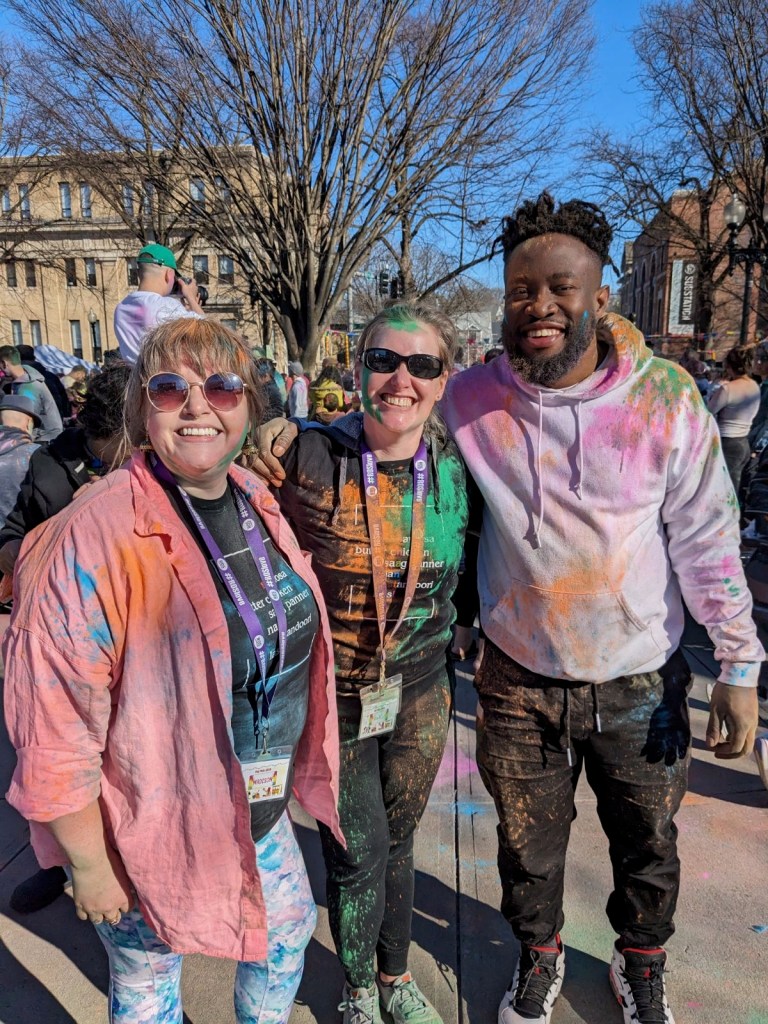
Holi happened in partnership with a restaurant named Shanti in Roslindale. We had been doing small events with them, and they told us that, as an Indian restaurant, this was a major celebration in their culture.
We had been thinking for years about how to do it, but we didn’t know what steps to take. I said, “Let’s go. Let’s just do it and figure it out as we go.”
The first Holi festival we hosted had around 3,000 to 4,000 people in the square. It was amazing to see adults become kids again, playing with colors and dancing around. It was a lot of fun, and now it has become a tradition in Roslindale. I think we’re on the third or fourth one.
Shanti was an amazing partner. My thinking was that the Roslindale community would show up. If you’re doing something unusual and exciting, people want to test it and see what it is.I spent many hours looking up Holi festivals. I thought that if we could capture even a small amount of that energy, people would be amazed. Holi in India is not just one festival at one establishment. It’s all over the city. It’s a vibe.
Shanti knew what they were doing and brought that energy to the event. They fully committed to it. As an event manager, I couldn’t have asked for a better partner. They were financially responsible for the event, which reduced some of my anxiety. They understood their community and knew how to reach Indian residents. One of our goals as a Main Street organization is to bring people into the neighborhood, so having people travel from outside Boston to attend the festival was a good thing.
You want people to say, “Roslindale — I know that place for this specific reason.”
How did it feel to run winter markets, especially outdoors in the snow?
That event was only possible because of partners. ABCD Roslindale is a nonprofit, and they lent us their parking lot on Sundays. We looked everywhere for a place to run the market during COVID. We couldn’t be indoors, and ABCD was the only organization that said, “We don’t use our parking lot on Sundays. Feel free to use it.” It was hard — very hard and physically tiring.
You’re asking businesses that participate as vendors to make a commitment even though it might snow or be freezing outside. Sometimes only ten people would show up to shop. From an operational point of view, that’s a difficult choice for some businesses. They stuck with it because they trusted my vision and believed in the community they were serving. At the height of the pandemic, outdoor markets were very popular, but by 2021 and 2022, people wanted to go back inside.
I was fortunate to run more than one market. I also ran the market at Oak Square in the parking lot near the Presentation School. That was the Brighton Winter Farmers Market.
Did you ever get tired of running farmers markets?
I don’t think I’ll ever get tired of it. People often ask how I’ve lasted nine years when the usual shelf life for a market manager in Roslindale is around two years.
You have to keep doing new things. You figure out the basic operation of the event and change it every year. You add more entertainment, add more community groups, and tweak different things. It’s like a little experiment. You already know the event is successful, so why not try other things and see how they shift it?
How did you develop that approach?
In architecture school, we have something called the iterative process. You make ten models for the same project, and the concept unfolds. You approach project presentations in the same way. You have a bunch of ideas that evolve from each other. You try different avenues, and one feels right — or maybe several feel right. You convince people that this is the avenue you should commit to exploring.
With the iterative process, you diagram, sketch, draft, and discard a lot of things. You might do something one way and realize that you don’t like the design or that it doesn’t meet the brief. There may be a few elements you like, so you bring them into something new. Doing that for a couple of years stays with you.
Was that process discouraging at first?
Architecture school was tough because no one tells you it’s going to be like that. You think, “I’m going to make 20 models before I get to my final project?”
When you enter the real world, it’s the same with clients. They ask you to tweak one thing and then another, and you are constantly building. Any creative form that involves collaborating with someone else goes through that process. Someone might add something, and later you look at it together and decide that you don’t like it. Then you change it. Sometimes there isn’t even a final version. There is just a point where you stop and pass it on to someone else to continue working on.
That’s what happens with some of the markets I manage. You pass them on to someone else to continue the process. If you don’t follow that process, things can become stale. Imagine creating an event and never changing it while the neighborhood’s demographics change. People may no longer be engaged with the event, and it no longer has the same value.
When you continue changing it, you have intentions behind it and build it with other people who also have intentions. If everyone is moving in the same direction, it’s a beautiful thing. You never get tired of it because you might get tired of your own ideas, but someone else can come up with a completely new way of viewing the project and give you energy again. You think, “I’ve never thought of it that way. Let’s see what this can be.”
How did you build the process of staying in touch with the community while also maintaining trust in other people?
It takes a very long time to do things by yourself. Sometimes it takes a long time with other people too, but you would be surprised by the connections people have and the amount of time they can contribute. As a leader, you have to stick to your intentions, but you can let go of the process. You can let other people help build it. When you think about communities, there are far more skill sets in a larger group than there are in one person.
How do you hope to apply your experience with underserved communities in Roslindale to Allston?
I’m absorbing everything about Allston — the good, the bad, everything. I’ve been walking around the neighborhood for the past four days. I’ve been meeting business owners and stakeholders and talking with them about their interests. Once you gather all that information, you can start to see how your intentions connect with what the community wants.
AVMS has a board that has been active in the neighborhood for a long time. They have a vision, and I like to think that during the hiring process, we saw that our visions could work together. They are my anchor in this community and the primary way I’m going to build with the community.
I don’t expect to step in and say, “I know everything about Allston, and Allston needs to have this or that.” It’s okay to start slowly, learn what Allston wants, and learn about underserved communities. What prevents people from showing up and participating? What excites them? If we did this, would it excite them enough to come out?
Do you have anything special in mind for the Haitian community in Allston?
I’ve learned that Allston has a large Brazilian and Haitian community. I’m willing to discover the Haitian community. So far, I’ve spoken more Creole in the Roslindale and Mattapan area than I have in Allston, but that doesn’t mean we can’t run events that invite the Haitian community. I think it would be very interesting. I’m thinking about immigrants in Allston in general. That’s what I bring to the table. I’m an immigrant who managed to create a life in this country, and that matters a lot to me.
It’s an experience I can connect with people through and use to help show them what is possible. Allston has a large international student population and many immigrant-owned businesses. I’m excited to meet them and ask, “What do we want to create together?” The answers should come from them rather than from me dictating what should happen.
If you had asked me a couple of years ago whether I would ever do a Holi festival, I probably would have said I didn’t know. But building a relationship with an Indian restaurant made it possible. They could educate me about what Holi is and how to do it. You become a little anxious because you wonder whether you are appropriating someone else’s culture. But when you have a partner from that community taking the lead, you can empower them. I had the event experience, and Shanti had the idea. We merged those things together and created the event.
What would you want to share with the Allston community about how people can interact with AVMS?
If you’re a local resident who lives in Allston, the best way to interact with AVMS is to volunteer with us. Tell us your ideas and offer your efforts. Help us move in the direction the neighborhood should go.
That could mean advocating, creating beautification projects, developing new events, or doing anything else that supports the neighborhood. If you’re a business owner, create a relationship with AVMS so there is mutual benefit. Businesses are trying to operate businesses, and AVMS is here to support them. We want to connect businesses with the city and help them access the information they need.
Businesses can also serve as partners by helping other businesses and new businesses learn about everything AVMS does.
How does this transition in your life reflect the direction you see your life moving?
You have to be adaptable in life. Leaving one Main Street and starting somewhere new in a different role will be the ultimate test of that, and I’m excited about it. From my college years and living in Brighton as a young adult, I know that this is where the fun is. You want to be where the fun is.
There are no neighborhoods I’ve lived in that are like Allston. You have a night scene and a day scene. It has everything.
You can even go online and watch the Meet Boston videos. They made one about every neighborhood. Look at the Allston one and compare it with the others.
What are your favorite spots in the neighborhood?
I want to shout out some places in Allston, although that might make some other business owners mad at me. I like everyone equally, but I’m still learning about a lot of new places. Yesterday, I went to Tous les Jours, a French restaurant. They had beautiful cakes, and I had never been there before. I wondered what had been holding me back. You get this feeling of exploring on a small scale, and it’s also happening on a larger scale. It’s fun.
There’s Lone Star, which I’ve been coming to for years. I love Roadrunner. I’ve seen Tash Sultana and a few other artists there. Roadrunner is great. Brighton Music Hall is great too.
Have you been going to Brighton Music Hall for years?
I’ve been going there since I moved to Brighton. They would have queer shows, and Tara Dickoff would perform there. I would think, “Yes, I love it. It’s a nice drag queen show. Let’s go.”