Where did this Tiny Doors idea spark from? What’s its origin story? I moved here last April, so a little over a year ago, and I started going to the Pet Shop. I love the Pet Shop. I started going in there because they have these huge dogs that are in there. I would go visit, and they’re so great, and they’re so sweet.
I wanted to do something to support the small businesses. I really liked going in the Pet Shop, just as an example, and saying hi to Jim, and we would talk. If I had an origin story, a villain origin story —
When I was a kid, I grew up outside Washington, D.C., in Maryland, in a little suburb neighborhood, sort of like Allston, and it had a lot of small businesses. It had a garden store, had a family-owned grocery store, and when I was in high school, the rents got increased. They drove everything up, and they drove out all the small businesses. They bulldozed the whole thing, and they replaced the fourth-generation family-owned grocery store with an Amazon Fresh.
This was when I was in high school, and I was maybe 15, 16. In that moment, when you’re 15, 16, you’re like, “This is so unjust. This is horrible.” But there’s nothing I can do. They built all these high-rise condos and luxury apartment buildings and an Amazon grocery store and fancy stuff, and basically drove out all the small businesses and the neighbors that had lived there in the town where I grew up.
So that’s always been in my mind: if I ever live anywhere else, I want to try to protect the small businesses that exist there. Try to “patron-ize” them, I guess is the word. Try to support them. Do something. But I don’t own a pet. Coming back to Jim’s pet shop, I would go in there all the time and say hi to Jim, and I really wanted to support the shop, but I literally don’t have a pet. So this is all in the back of my mind.
Then I went to Atlanta for vacation last year, and there is a project in Atlanta called Tiny Doors Atlanta. I ran into one of the tiny doors. I was walking around Atlanta with my partner, and we saw one.
What was the moment you saw the Tiny Doors in Atlanta like? The project there is a little bit different. It was at the Botanical Gardens in Atlanta.
There’s 40, 50 doors. There’s a lot of doors. What’s different about that project, though, is that all the doors in Atlanta were done by one artist. She did them all, and it’s her career. Places pay to have a tiny door there.
For instance, the botanical garden pays to have a tiny door. So it’s a different model, but I thought, these are really cute. How could we take this idea and shift it into a community development project?
How long did it take for you to stew on that idea and then turn it into something with other people? I did what I do when I have most of my ideas, which is ask someone else. Pretty much the week I got back from Atlanta.
I feel like Allston is one of those neighborhoods where, when tourists come or college kids move here and they Google what to do in Boston, nothing that they come up with is in Allston. Tourists don’t really come out here.
People who Google what to do in Boston don’t come out here. I think most college students go all four years without ever making it out here, unless they went to BU. I wanted to change that. We’re just as much of a destination as Back Bay or Fenway or anything like that. Newbury Street? You should come here. Come here to Allston. That’s what I wanted.
I emailed Alex at Allston Village Main Streets, and I was like, “I have an idea, and it seems like Allston Village Main Streets is the place to go if you have an idea.” And I was right. Alex was like, “Let’s hear about it. Tell me about it. Let’s meet. Let’s talk about it.” So we did, and he helped me. He was like, “You can make a project proposal,” and all this stuff. He helped me set up a meeting to pitch it to the board, and they agreed to fund the project, which was really cool.
What was the funding from AVMS used for? What the funding really is, 80% of it is going back to artists. I mean, 80% is an estimate. That’s not an actual calculated number, but we paid all the artists to make the tiny doors. It was a paid opportunity for artists. We paid someone to design the passport. We paid a local artist to do the logo. Most of the funding was for paying and goes back into our local artist community, which I really appreciate.
How did a project like this logistically unfold? I think we made the project proposal in the fall, and then maybe it was December or January that we got approval from Allston Village Main Streets’ board to have the funding to run the project.
Then we started in February and March with hiring a graphic designer who’s also from Allston to do the logo. Mo. They’re tagged in one of my Instagram posts. They’re doing some other cool stuff as well. Mo is a graphic designer who does a lot of stuff and has lived here in the area for a long time, so I think pretty well known.
Then maybe that was winter, and we launched an Instagram and put out a call for artists and tried to get as many artists as possible to apply to do tiny doors. It was really cool to see all the different people that applied and all the different mediums. One thing we really wanted in this project was to have a bunch of different mediums. Some of the tiny doors are sculpted with clay. Some of the tiny doors might be wood. Some might be found objects. Some are needle felting. Some are painted. So we wanted that range of mediums.
What were the artist responses that really piqued you? We picked people who we felt had a good grasp on the project.
I put a scenario question in the application, which was, if you could design a tiny door for Dunkin, what would it be like?
Almost everyone said, “I would use the pink and orange,” which was cool. The responses that really tipped me off as someone we wanted to include in the project were people who said, “I would first ask the owner or the manager of the Dunkin what they wanted.”

Because we really wanted this to be a collaborative art project. At the end of the day, if you own a small business, which I don’t, but my understanding is that if you own a small business, that business is like your child. It’s your pride and joy, and so anything that you’re going to display in there, you want it to be something you love. We wanted our artists to understand that this needs to be really collaborative with the business, and that ultimately the result will be better if it’s a collaborative process. We were looking for artists who were ready to embrace that.
What was it like gathering all of the doors together? How did you start mounting them? Gathering the doors was a little chaotic because I just had surgery, so I literally couldn’t move. Primarily, what we did was, I said I would hang them myself, but I invited artists, if they wanted to hang them themselves, they could, and most of our artists wanted to do that. I think because they wanted to show the business — it was their first time seeing it.
There was a requirement that they meet with the business in advance to discuss the design parameters and get inspiration, so that they make sure that what the final product is something the business agrees to. The business had some idea of what was going to be created, but most of the artists brought the final piece themselves and hung it up themselves. I was really pleased, and they all sent me pictures of them and the owner together with the door.
What are you trying to say with these doors? I think that came about effectively by accident. It wasn’t something I set out for. When I started with this, my goal was to support local businesses. I didn’t really think about what would end up happening, but ultimately we built these relationships between local artists and local business owners, and simultaneously the local Allston Brighton community. I got to see that unfold as the project went on.
One of my favorite things was that I asked the artists to email their businesses. They mostly copied me on the emails just to be nice, but I didn’t have anything to say, so I was just copied. I got to watch them email each other back and forth and form this connection. One would email and be like, “What do you think if we did this?” And the business would be like, “I think that’s great.”
Then they’d email, and it was like watching a friendship be born. I was just sitting back and watching this happen, and it was a really beautiful moment.
At the same time, releasing the passport, I’ve got to see every day. I see more people submit their finished passport. I’m getting to see the trickle-in of people that have discovered our neighborhood, gotten to know our neighborhood, and discovered our local businesses and our local artists because of this project. I hadn’t thought about the bigger implications of this when I started, but now that it’s happening, I’m really seeing it, and I think it’s very cool.
It’s been up for a week, and we’ve had six people do it, which I feel is pretty good for a week. We’re just starting to promote. I love this comment where someone put, “I walk by these storefronts all the time, but the project made me slow down and take in all the little details about our neighborhood businesses.” Some stranger put that, and that was really nice.
This person said, “Different mediums. I like how each artist approached it differently,” making a business. They added mascots and pets. Seeing those comments drove home for me that this was about more than art or more than business. It was about connecting people in our community in a way that I think is really meaningful.
What did it feel like to manage this project? I’ve never managed a public art project or anything like this before. I have managed other projects and programs and things like that, but never something like this.
I was really excited about it. All through the process, I was pretty excited about it. This has given me a lot of energy over the last couple weeks. Don’t get me wrong, it’s been a lot of work, but it’s given me a lot of energy and motivation over the last months that I’ve been doing it.
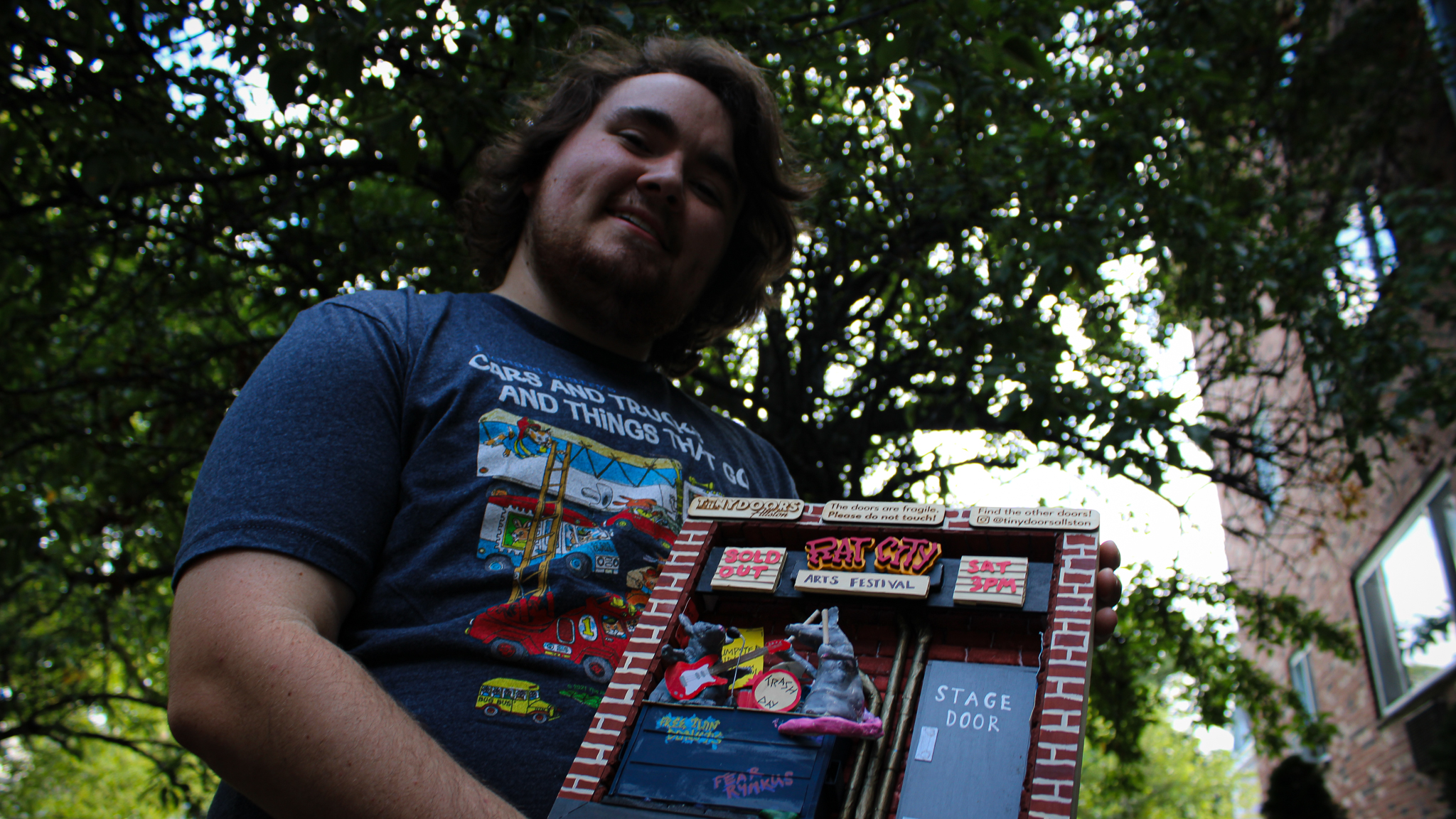
I really like being the person that just gets to start something and then step back and see where other people take it. From the beginning, I was like, I don’t really want to be a part of this in the sense that I don’t want to build a tiny door. I did build one for fun because it looked really fun. I put it out as an advertisement tiny door at the Rat City Art Festival. But I liked being able to set people up with relationships in the community and build relationships in the community, and then let them carry that forward. Or being able to give someone a prompt and see what they did with it. I think that was pretty cool.
Why is it so important that we have this kind of art in the neighborhood? I think it’s significant because, in general, it’s significant that we are active participants in our community. Regardless of what that looks like, it can look like public art. It can look like supporting local businesses. It could look like submitting reports to 311. I think it’s important that people engage in their community. If you live somewhere, that you explore the place that you live.
I think this is another touch point for that. The more touch points we have for people to explore the place they live, the more they care about the place they live, and the more engaged they are in the place they live.
What were some moments that made this work feel really fulfilling? When the first person submitted their passport—that they had done it—I was really excited. When you do something like this, there’s always a part of you that’s nervous. How is it going to go? At that point, we hadn’t promoted it at all. From here on out, we’re really going to try to promote this more to get more people to know about it and do it.
When the first person did it, that was a big moment for me, where I was like, even if no one else does it, I made one person have a deeper relationship with their community, and that’s what I wanted. If this is as good as it gets, then this is awesome. That was big.
Getting the emails from the businesses after they saw it was really cool. After the artist installed it, I went into all the different businesses with my broken knee and handed them stacks of the passports to be able to give out at the businesses. Hearing their feedback meant a lot.
What more are you hoping for for this project? Right now, I’m really focused on promoting what we have. I want as many people to do Tiny Doors Allston and go visit the mall and earn the prize. There’s a prize between the mall. I want as many people to do that as possible, and really see how it goes and how far we can push this.
For the future, months ahead or years ahead, I would like to see if there’s an interest from any other communities in doing this. If Brighton is interested, we’ve seen some interest. I’ve had people email me and write to me and be like, “Cambridge would be perfect for this. Somerville would be perfect for this. Brighton would be perfect for this.” I totally agree, and so I’d love to do it in other neighborhoods. But at the end of the day, I try to listen to what the community wants. If this is something other people are into and other communities are into, then I’m here for it.
Did you expect the project to unfold like this? I have a pretty wild imagination. When I take on a project, I tend to full send it. I tend to commit. I did not imagine it would be what it is. I think 10 was ambitious. To do ten doors was ambitious, and I’m really pleased with how it went. I’m very satisfied with the result, and I feel like we really pulled it off.
I didn’t really know how into it people would be. I wasn’t sure if this was, am I the only one that thinks this is cool? Am I the only one that finds these cute? Maybe other people aren’t interested. But people have been pretty interested so far, and I wouldn’t say I’m surprised, but that part I definitely didn’t anticipate—that people would actually be excited.
What would you say to other Allston neighbors who have an idea? I would say to anybody, but especially in this neighborhood that’s so well supported in this way, if you have an idea, just do something.
I think there’s a lot of people who have really great ideas, but then it just kind of ends with an idea, and that’s okay. A lot of my ideas end with ideas.
But in general, if you’re someone that lives in the neighborhood and you have an idea, whether it’s, “I really want to have a stop sign right here,” or, “I really want to have this public art project,” or we have a neighbor who’s doing a Lower Allston Cat Stroll. That was her idea. She was like, “I’ve heard about cat strolls. I really want to do a cat stroll,” and she’s making that happen.
I would say to neighbors, don’t underestimate yourself. If you have an idea, do something about it, and you can make it happen.