
|
Getting your Trinity Audio player ready…
|
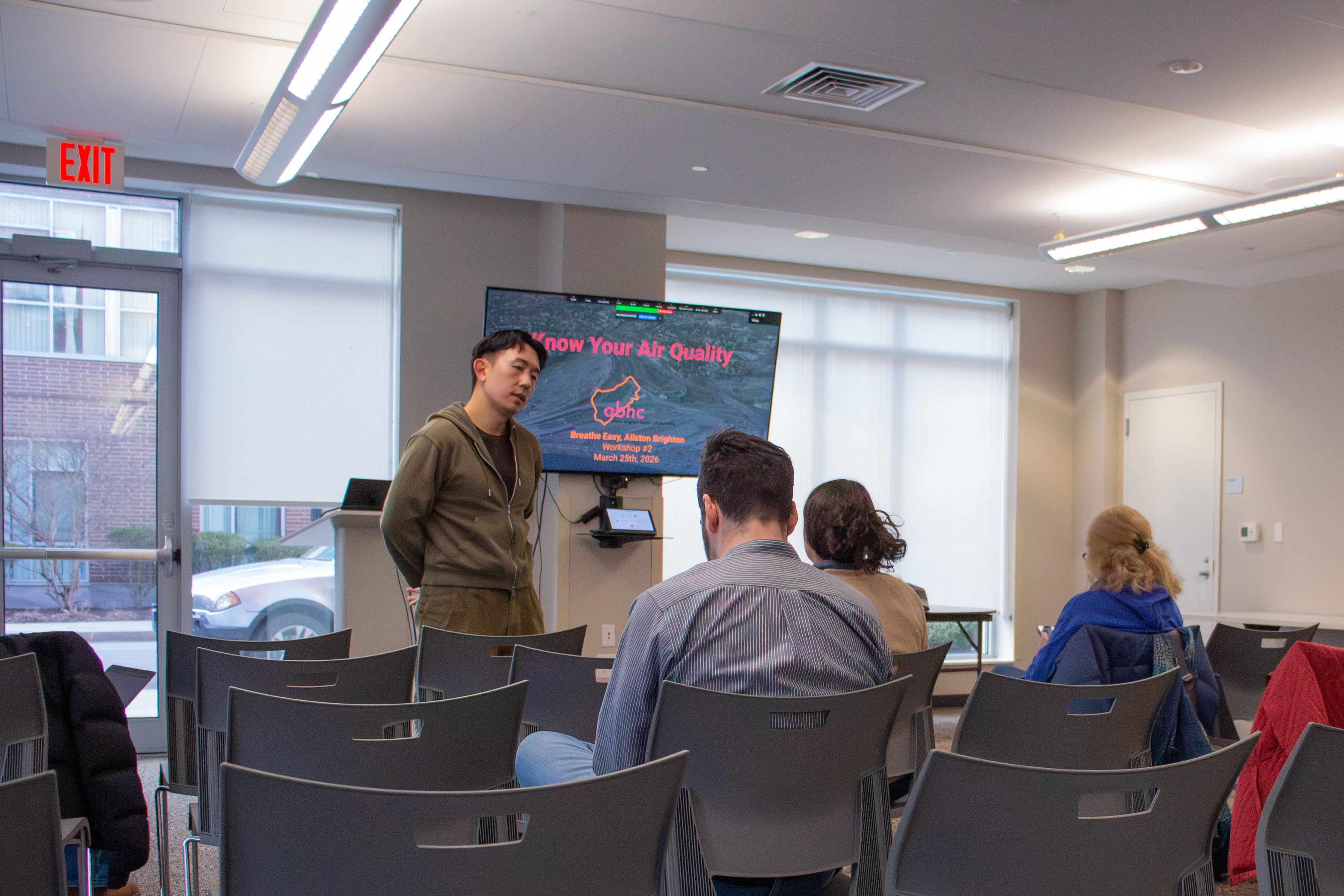
The Allston-Brighton Health Collaborative (ABHC) showed how Allston-Brighton residents can interpret real-time air quality data on an interactive map at its latest workshop on March 25.
The workshop is part of a six-part series for ABHC’s “Breathe Easy, Allston-Brighton” initiative, which will compile air quality data from 30 indoor and 30 outdoor Purple Air sensors installed in neighbors’ homes over a year.
Each dot on the Purple Air map represents a Purple Air sensor. The sensors use lasers to estimate the number and size of air particles. They convert the reading into a number corresponding to the standardized Air Quality Index (AQI) determined by the Environmental Protection Agency.
Users can also access air quality maps on apps like Paku and AirCare, which present Purple Air’s data in a more user-friendly format, Jonathan Lee, who’s helping lead the project, said.
Victoria A. Lopez, who is also co-leading the project, said ABHC has already installed over 15 outdoor air sensors.
Lopez and Lee oversee the installations and troubleshoot any issues between the sensors and the map display, checking the map at least once a day.
So far, the sensor readings fall inside the AQI range for satisfactory or low-risk pollution levels.
“Hopefully, [the good air quality levels] continue into the summer, but we know that wildfire season is coming soon,” Lee, the transportation and mobility manager at ABHC, said. “It’ll be good for neighbors to be able to see air quality data there.”
Sometimes, air quality shows negative spikes in the winter due to trapped air, Lee said. Weather can also impact temporary air quality — rain can reduce pollution.

In addition to seasonal changes, residents asked how smoking, traffic congestion and construction could impact air sensor readings.
Jasmine Laietmark, a 15-year Allston-Brighton resident who has lived in Boston for 28 years, says she’s curious about how gas prices could impact air quality.
“During the pandemic, all kinds of changes happened,” Laietmark said. “We saw wildlife come back, and we saw cleaner air.”
A smoker near one of the outdoor sensors raised its air quality reading during the workshop’s live demo of the map. Attendees asked if the Purple Air sensors could detect which particles were in the air.
Lopez said that the low-cost Purple Air sensors can’t measure the exact types of particles that are in the air, like the “gold standard” air sensors.
However, Northeastern University’s iSUPER van can measure particles, like nitrogen dioxide, ozone and pollutants that are generated from traffic or automobile vehicles, Lee said. The team will complete their first drive through the neighborhood in April.
Northeastern University researchers, who are partners on the project, will analyze the data. At the workshop, ABHC asked neighbors to offer any research questions they wanted researchers to consider for their study.
“[This event showed] that we as neighbors can participate collaboratively to build this information and to help our community,” Laietmark said. “Even just having the data is helping our neighbors think more about the air that we’re breathing in.”
Genesis Lara, a four-year Allston-Brighton resident and a project manager at Allston Village Main Street, said it’s good to know that she’s breathing in clean air.
Lara says her environmental interests and curiosity brought her to the initiative’s workshop, which she only recently learned about.
“It’s actually really exciting to see how involved everyone was and asking the right questions,” Lara said. “I also care for the environment, and I love that we have these workshops open for the public.”
Nikhil Dasgupta, ABHC’s engagement and operations manager, said it’s important to give community members access to live scientific data.
“Our job is to connect this great tool with the community and create a living connection,” Dasgupta said.
Dasgupta oversees community outreach on social media, facilitates the workshops and communicates with the city, who funds the initiative.
Lee said all 30 sensors will be installed by the end of April, and ABHC will hand out air purifiers to study participants in the summer. The next workshop will address how participants can prepare themselves for air quality impacted by wildfires. The team will also show neighbors how to make their own air purification systems using box fans in a future workshop.
