
|
Getting your Trinity Audio player ready…
|
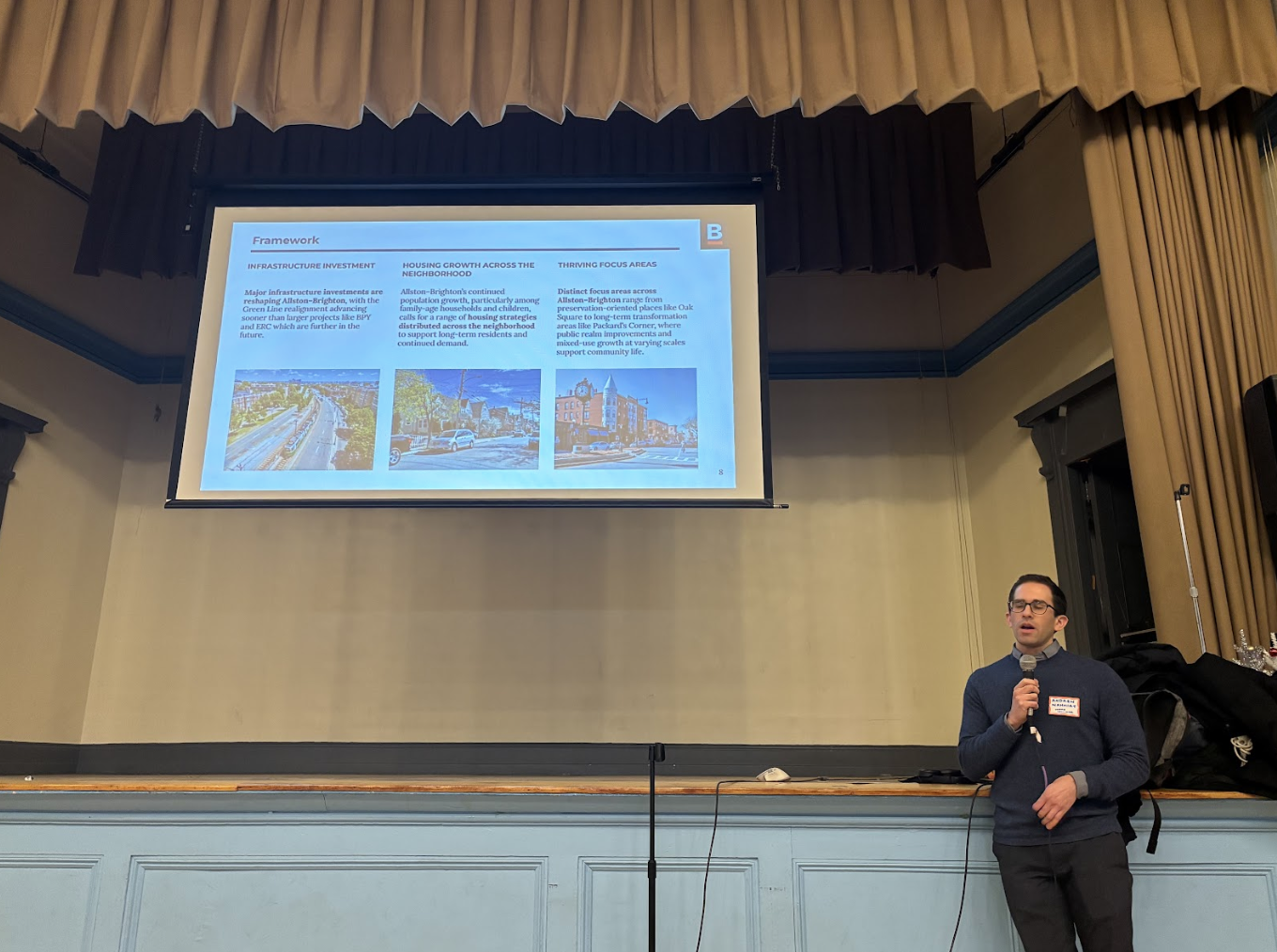
City of Boston Boston Planning Department (BPDA) met with residents at Boston Green Academy (20 Warren Street) on February 11 to discuss the Allston-Brighton Community Plan, a zoning restructuring effort focused on affordable housing, transportation, and open space improvements.
BPDA team members Grey Black, Andrew Nahmias, and Jack Halverson outlined Boston’s zoning framework, the history of citywide zoning laws, and the goals of the Community Plan. Ultimately, the plan would produce a land use framework and rezoning recommendations for the City.
Halverson spoke about how restructuring zoning laws will help Allston-Brighton create more affordable housing, be beneficial to small businesses, and revitalize its vibrant arts scene. One major objective is implementing contextual residential zoning, designed to ensure that new construction and renovations match the scale and character of existing neighborhood buildings.
The team also mentioned that having a different set of zoning rules for mixed-use shopping centers in the neighborhood would benefit smaller businesses and bolster activity in those areas.
“Some of the ways that we can make this happen are by requiring certain land uses to be on the ground floor in some locations. So these could be requirements for things like restaurants, shops, community centers, and other things that are really activating in the street in some places,” he says. “Generally allowing for more of a diverse range of land uses can really alleviate barriers for new small businesses to open up.”
While many residents expressed optimism about the potential benefits of the plan, others voiced concerns.
Pam Mullaney, a local union organizer, questioned whether the current city administration would move quickly enough to implement zoning changes.
“I would like to see the administration move more quickly in effecting zoning change because of the housing prices,” she said. “I personally would like my kids to be able to live close to where they grew up in. Right now, that’s just not possible.”
Mullaney also had concerns about developers building housing higher than six stories under the new Community Plan, citing a rule that requires housing built above six stories to be built with steel. She argues that the high costs associated with steel make these units difficult to sell or rent at reasonable prices, citing these regulatory expenses as a primary driver of the housing shortage.
“It becomes really, really difficult for them to either sell or rent those units,” she said. “People need to know that’s one of the reasons we don’t have enough housing.”
Brandon Stanaway, another resident attending the meeting, is concerned that public transportation is not getting as much attention as a component of the Community Plan as it should be.
“Ultimately, I think the answer is to start with housing,” he said. “That requires us to build the housing, have more people and a little bit of congestion, whether that be through car, pedestrian or bike, and then the transportation system can adjust to that based on the revealed preferences of the people who end up living there.”
Stanaway also expressed concern that the arts community is not receiving enough attention in the planning process. He advocated for more artist housing and additional spaces for artists to showcase their work.
Despite the neighbors’ concerns, some like Brighton resident Julie Kenny remain optimistic. Her two daughters who are recent college graduates moved back home. She hopes the Community Plan will help make the neighborhood more affordable.
“Rents are really huge, and that’s why they’re at home,” she said. “I’m hopeful that some of the zoning and building that they’re going to do will help that to happen.” ■
