|
Getting your Trinity Audio player ready…
|
At the beginning of the year, Allston-Brighton’s wastewater had higher levels of viral load than the citywide average which indicated an elevated risk of infection. These numbers in the community continue to fluctuate, but COVID-19 wastewater levels are currently very low across all Boston neighborhoods.
Allston resident and Boston University student Chikako Hirakawa recently noticed that a lot of people were sick and figured it was from being in college. She said she was not aware of wastewater testing in Allston-Brighton until presented with BPHC’s data.
“Because I live in an apartment complex, the only information I get is from the company that manages the building,” said Hirakawa. “They could inform us more.”
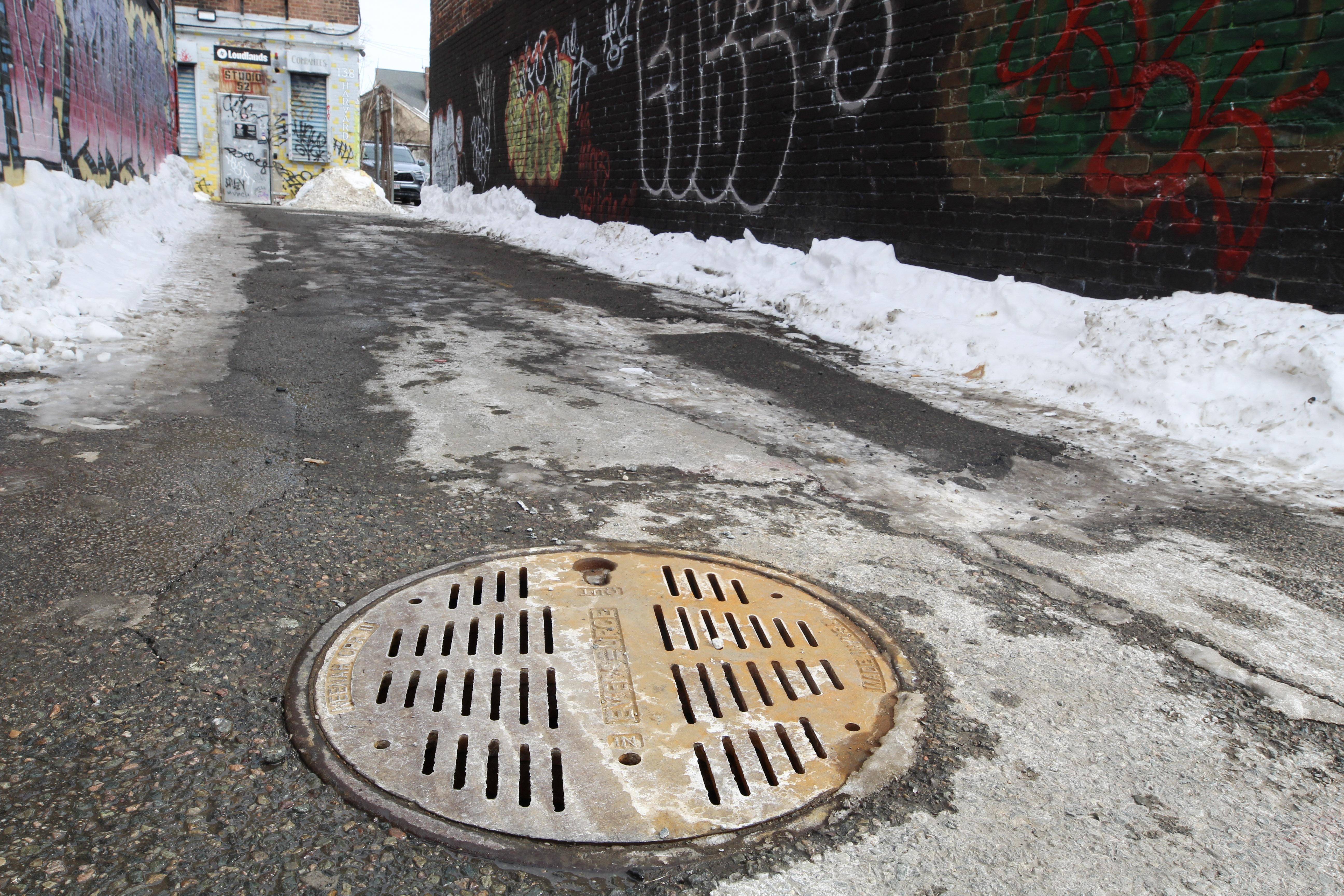
The Boston Public Health Commission collects samples of wastewater twice a week from 11 sewer holes in 10 neighborhoods throughout Boston and sends them to GT Molecular’s laboratories in Colorado. They perform a PCR test on the collected samples to measure how many copies of virus RNA, shedded by individuals who are sick with diseases like COVID-19, RSV, and the flu, are present in the wastewater, according to the Boston Public Health Commission’s wastewater monitoring program.
There was an average of 961 copies of virus per millimeter which was higher than the citywide average of 60 copies, according to a January 6 Boston report from the Boston Public Health Commission. The level of virus indicated a very high risk of COVID-19 infection, according to the health commission’s concentration level categories.

“We know large indoor gatherings during the holidays and winter months are times when respiratory viruses can spread more easily,” according to an emailed statement from a BPHC spokesperson. “This factor may have contributed to the level of COVID-19 found in wastewater in some neighborhoods in recent weeks.”
The January 6 report showed Allston-Brighton’s numbers had a “large increase” of 960 copies of virus per milliliter compared to two weeks before. By the next week, viral levels dropped to 50 copies of virus per milliliter.
There was a slight uptick in the January 26 report, but a Boston Public Health Commission spokesperson said college students returning for their spring semester following the Martin Luther King Jr. Day weekend could be a possible cause for these numbers. In the past two weeks, viral levels have hovered below 100 copies per milliliter.
In an interview, Dr. Robert Horsburgh, an infectious disease expert and Professor of Epidemiology at Boston University, cautioned community members from reading too much into percent increases.
He said that while these tests are a useful new technology, interpretation can be difficult. The large percent increase of a given week is a comparison to prior weeks, but the overall value of viral load could be low.
“It’s a huge increase, but it’s still a small number, so this probably suggests that there’s not that much virus of all any of the three kinds circulating,” said Horsburgh, referring to the uptick of viral levels in the January 26 report.
Unless the baseline is at least 100 copies of virus per millimeter, he explained, a percent change “doesn’t mean anything.” The absolute value of viral load might be more informative. The Boston Public Health Commission designates levels between 240 and 320 copies per milliliter as “high” and those above 320 as “very high.” The viral level for COVID-19 in the January 26 report was 158 copies per milliliter.

Horsburgh said that it’s also important to view the wastewater results in the context of hospitalized cases, which have remained low. A discrepancy between low cases and high viral loads could be a result of people, who harbor the virus, either are not getting sick at all or are not experiencing severe symptoms. to be hospitalized.
A Boston Public Health Commission spokesperson explained that they collect these wastewater samples anonymously and on a community-scale, so it does not act as the sole explanation for why levels of virus are higher in some neighborhoods like Allston-Brighton compared to others.
Horsburgh pointed out that neighbors should keep sample sizes in mind when it comes to interpreting percent increases in wastewater results, particularly in a neighborhood with a large student population like Allston.
“If there weren’t that many people in Allston-Brighton over the holidays, and all of a sudden a whole bunch of people came back. You’d expect to see a little bump, but you wouldn’t expect to see a lot of people come into the hospital. And we didn’t,” he said. “It doesn’t mean there’s an outbreak. It could mean just a lot of people came to town and therefore added to the baseline.”
“It’s really a statistical aberration and not an important increase.”
However, wastewater monitoring can anticipate the spread of disease in a community, acting as an “early warning system.” It signifies a viral presence before individuals recognize symptoms of disease and informs public health officials and agencies of a potential outbreak, according to the city
“We check the wastewater, we see what’s happening, and, if it really starts to go up, we know that something’s percolating,” Horsburgh said. ◼