|
Getting your Trinity Audio player ready…
|
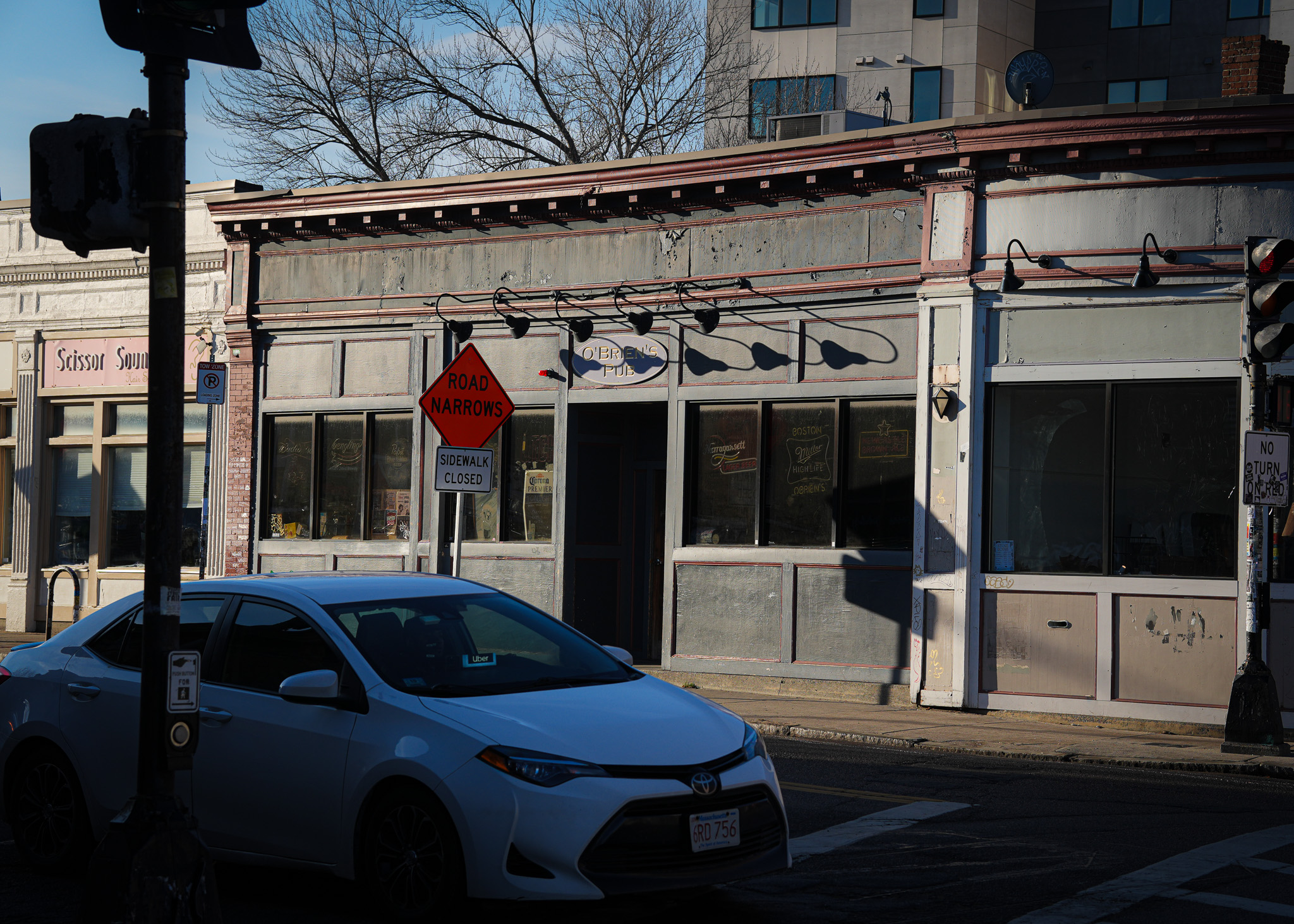
After its approval by the Zoning Board in September, the redevelopment of 1 Harvard Avenue — a nine-story building constituting the return of the iconic music venue Great Scott, retention of O’Briens Pub, and more than 130 rental units — is fully underway in its detailed design phase.
According to project principal Jordan Warshaw, the first stage of this phase is the most important part of the process for the community and the City. During this stage, known as conceptual planning, developers and architects work together to make major decisions about the floor and exterior design and generate the early floor plans that determine unit dimensions. This planning takes a total of 16 to 20 weeks and will conclude in Spring 2026.
One priority for the project is to create a look to the development that is distinct from the conventional projects in the City.

Warshaw explains that new residential buildings “have a similar look to them around all over the country,” but that the 1 Harvard Avenue redevelopment is intended to signal its connection to music and arts. “We’re trying to create a look for the building visually that says this is a little bit different […] something that doesn’t just look like a standard apartment building that happens to have two music venues on the first floor,” he says.
One design nod includes a modernized version of Great Scott’s iconic green awning. “We didn’t want to just replicate the old tattered green awning, but we wanted it to be a green awning,” says Warshaw. “Our architects designed a new green awning that’s made out of perforated metal […] a symbol of Great Scott, but it’s a new, different green awning.”

Great Scott had closed its doors at 1222 Commonwealth Avenue in 2020.
While design work continues, Warshaw explains that a challenge for his team is navigating high construction costs and making the project financially feasible. “The longer things drag out, the more they wind up costing,” says Warshaw.
For instance, cost played a key part in the decision to not include building an underground garage in the development, which could cost between ten and 20 million dollars. “Those are the types of things that we’re doing to try and make sure that this building can happen,” he says.
In the April 2025 plan of Great Scott’s redevelopment, the site has three units of offstreet parking, which are for carshare vehicles.
For neighbors like Scott Matalon, owner of the now-closed Stingray Tattoo on 1 Harvard Avenue and local musician, the lack of on-site parking raises a concern.
“If you’re a guitar player and you’ve got an amplifier and a head and a stack, or you’re a bass player, those things are heavy,” says Matalon. “They’re not going to just let you on the train with all this stuff.”
In response to concerns like Matalon’s, the project development team has expressed a commitment to ensuring off-site parking for band vehicles. While a formal agreement with the Boston Transportation Department has not been made, Warshaw expects that the site “will also include several spaces in front of the venue marked as ‘loading zones’ during certain hours of the day” to “accommodate band load-in and load-out.”
At the same time, Matalon expresses excitement about the opportunities that Great Scott and O’Briens Pub will provide for newer artists in the neighborhood.
“Great Scott and the Midway, and all the clubs that used to exist like Bunratty’s and the Rathskeller, Jumpin’ Jack Flash, were important because they played people that the record companies never looked at, that the record companies overlooked, that the record companies rejected,” says Matalon. “But we would never have the Ramones, Blondie, Talking Heads […] if it wasn’t for these local clubs that are run by real people. The Rathskeller was run by Jimmy Harold. Chet’s Last call was run by Chet. These are people who loved music. They loved local musicians.”
He calls the local club “a fertilizer,” saying that what makes American music great is this “coming-up-from-the-ground swell.” For him, local clubs that often play multiple bands in a night allow for “cross pollination” between fans and between bands.
“The guys who own Great Scott bought it because they love local music. They’re not trying to turn it into some giant thing that’s corporate,” he adds. “They want it to be like O’Briens, geared towards unsigned bands or people on their own labels that are traveling around the country in a little van with no support, trying to make it. That’s what’s so important about those clubs.”
As the project moves forward, both developers and neighbors hope the revived Great Scott and the continued presence of O’Brien’s will help strengthen the area’s musical fabric. “We’re really happy to see that both of these clubs are going into this location,” Matalon said. “We need more of them.” ■