
|
Getting your Trinity Audio player ready…
|
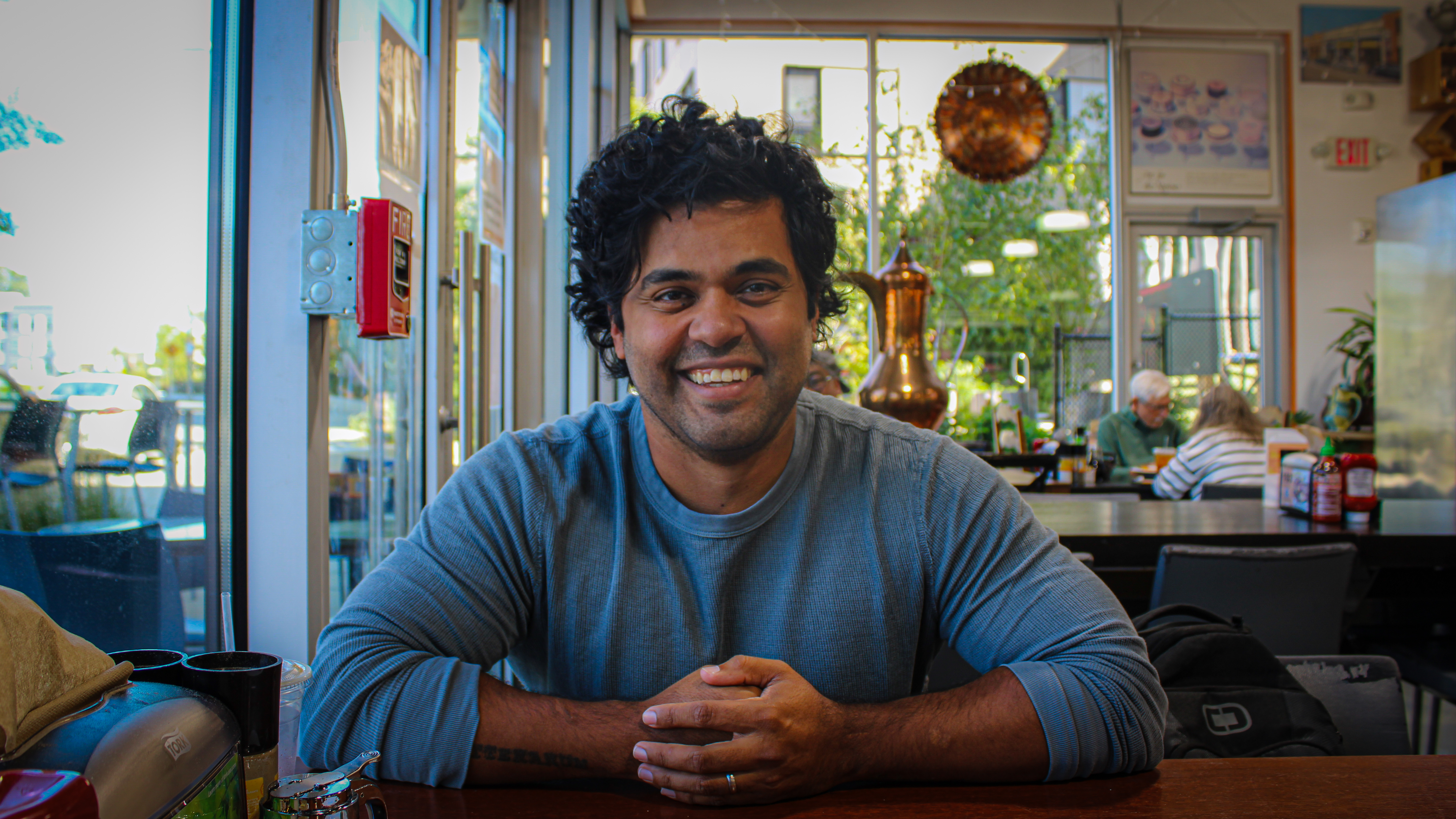
Oscar and I meet at In House Cafe (132 Chestnut Hill Ave) in Brighton. As we talk, we are given a plate of baklava. It tastes warm and bright — like the cafe itself. Sunlight streams through the large windows onto the tables, which seem to be equally as large.
This interview has been edited for clarity.
How did your relationship begin with Allston? I’m not even sure if I classify it as a relationship. It’s just my hometown where I was born and raised before on Commonwealth Avenue (Comm. Ave) in between BC (Boston College) and BU (Boston University) so right next to the B line. Really loud.
Now that I’m South Shore Swansea, I miss the train, and I can’t stand crickets out there, so I’m really excited to be back. What really ties me to this place is just the community I was in.
For the longest time, I went to the West End House Boys and Girls Club (105 Allston St). I still sit on the board of advisors there. It was where I learned how to swim. I played soccer with all my friends. And it was really a spot to build community. I like helping out kids. Helping them get into college and or trade schools. And so that’s kind of one of the big things in this tight-knit neighborhood — and what I love about the neighborhood so much.
How did you get involved in the West End House? I have four older sisters, and they all said, “Don’t go to the West End House. People are gonna mess with you. Don’t do all that.” Out of some active rebellion, me and my twin brother decided, one day, to go check it out. When we were between the ages 9 or 10. We went there and realized that this is nothing like they’ve been telling us. They’d just gone through a big renovation. We went there one day and we never stopped going there. It’s a place we could hang out after school. It helped us out a lot, and we had a place to hang out after school.
What’s the importance of spaces like the West End House? I feel like third spaces are also more important than ever. Perfect example, you talk with my former boss Kevin Honan. In the era he grew up in, there were libraries, bowling alleys, basketball leagues.
It’s more important now than ever to fund those spaces, invest in those spaces, because I don’t know where we’re getting those spaces from anymore.
So you’re working at Charlesview Inc. (123 Antwerp St) now , an affordable housing complex and community center in Allston. What do you do there? I’m the Housing and Community Engagement Manager, and three tent poles that I have are: a) educate the community about what type of housing and what type of consensus we want to build around housing. b) disseminate and help build up a bigger, better conversation around what type of housing is coming down. And last but not least, really do a lot more research around housing policies and housing practices, not just in Allston-Brighton, but hopefully for the city. So hopefully we can take good ideas that are happening in Cambridge, Somerville, or even in cities like San Diego, Seattle, Chicago, and implement them here.
What fond memories do you have of growing up in Allston? Allston for me was just that little strip of Comm. Ave to West End House and Ringer Park (85 Allston St). Then going up to Brighton High, because that’s where I went to high school. Growing up, it was just running up and down Comm. Ave all the way up towards BC, and then coming back down Chestnut Hill, going to the pool, and then hanging out at Ringer Park a lot.
It wasn’t as nice as it is now. There have been a lot of improvements. Back then it was really just the biggest hill that you run up and down, hang out on the rocks, and chuck acorns at each other. We didn’t do a lot.
We had Super Soaker fights too, that was a big thing. I have no idea what Super Soaker fights are. Super Soaker fights — oh my God, this is the first time, ugh, no! — oh my God, dude, it makes me feel so old when I know I’m gonna have this conversation with my daughter. [Lopez has a two-year-old daughter.]
You know what a floppy disk is? Yes. Okay, so, yeah, this is one of those moments. A Super Soaker is basically a water gun. Oh my God. It’s the first time it’s ever happened. Life is flashing before me! No, it was really about not having a bike, just walking and running everywhere. Growing up, playing cops and robbers. Nothing special or different.
It was just I had a place to go and interact with a whole bunch of other kids — not only just the street I lived on, but also the community center I had. Which is why it’s so important to have a community center.
How did your family influence your work in the non-profit and advocacy space? When I was young, my dad was the type of guy to go around, walk his block, check in on all the neighbors, and be like, “Hey. How you doing?”
We had a lot of people either on that street, either in the same situation we were in, or they would have just immigrated to the country. My father would always buy used cars from some of his buddies, who would get bad deals. And these used cars — which he’s still buying now, he has this Volkswagen that’s sitting up on blocks, and he’s like, “I’m gonna fix it.” I highly suspect he buys them to help them out. It’s this machismo thing where you don’t necessarily give people money, but you help them out in different ways. So one of the ways is he’ll buy the car from you, even if it’s a shitbox, and help fix it up himself.
From a young age, it was very instilled in me that you give back and you help out, and you find ways to make sure that your community is okay, even if it’s just walking the block, checking in on people.
It really magnified to an extent when I was at the West End House, making sure that kids that came into the doors were “Hey, this is a safe space. You get a couple snacks, maybe some lunch, maybe your first warm meal of the day, homework help, and you just get to hang out.” A lot of the kids we worked with were either coming from at the time when I was working there, either single-parent homes, or they’re being raised by their grandparents and what have you. It wasn’t a huge population, but we worked with a lot of public school students across public schools, mainly Jackson Mann (40 Armington St), Mary Lyons, Gardner Pilot Academy (30 Athol St), and so I was born and raised right there.
Allston’s diversity may sometimes lead to competing interests when it comes to housing policy. What is your approach to mediating these sorts of conversations? My biggest tool in the tool bag is — everybody just wants to be heard. If you structure any type of conversation so everyone feels they have a right to live in the neighborhood — especially a neighborhood as great as Allston-Brighton — it makes it easier to have an honest conversation about what the neighborhood needs.
If someone has a problem with whatever’s going on, you just want to hear them out. Then after that, you can dissect what we can do to help, and what you can do to move forward. One of the bigger concerns in such a diverse neighborhood is making sure people see the strengths of diversity: “Do you want to continue to have a diverse neighborhood? Here’s how we go about it.”
Like anything, there’s give and take. You can’t get everything you want, but you can fight for the things that are most important. One of the things to fight for in Allston-Brighton is the diversity we have here, and in order to keep that diversity, we need to build a certain amount of housing.
Working for Rep. Honan really opened my eyes to realizing there’s a lot of different ways to crack a neck and making sure that you know if there’s an idea you want to see through, you really need to build consensus. Sometimes building consensus in this neighborhood can be very difficult, because when you’re talking about Lower Allston versus Allston-proper or Comm. Ave versus parts of Brighton versus Oak Square, where it’s completely different worlds. You wouldn’t expect them in the same neighborhood, but they are but it works really well.
It’s been super helpful to have conversations with both people, especially since I grew up in the neighborhood as a renter, and then talking to homeowners. My biggest card I play with most people is like I was a renter my entire life. I was not a homeowner. My family weren’t homeowners, but we were able to stay here because we had CDC (Community Development Corporation) housing, and we were able to stay within the neighborhood because it was affordable for us to live.
That’s not the case for a lot of people now or even then, and so it feels like we need more of that in order to help. A lot of people talk about “Families are leaving, people are leaving.” There’s a lot of different reasons for that, but one of the biggest reasons is the housing here sucks. In order to help grow more housing, a lot more conversations need to be had with a lot of different stakeholders, not only just homeowners. It’s really a lot of nonprofit organizations, a lot of developers.
In this new role at Charlesview Inc., what plans do you have? One of the things that happens when a developer comes in and is seeking variances, they usually do a community benefits package. And so I’m working with Malaya Hayes from City Councilor Liz Breadon’s office in order to ascertain: Which developer has promised something? Has that promise been met?
And the other project is — whenever we’re talking about housing, we should also be talking about transportation, because in a city like Boston, it’s super inextricably linked.
What makes it worth it for you to come back to Allston and do this advocacy work? I love it. I want to keep it weird. No. I really, just, I really love this neighborhood. I never wanted to leave in the first place. But, you know, life being what it is and what happens, it happens. I just love this neighborhood, and I want to see it do better. That’s all. I really like it.
As an avid reader, do you have any book recommendations for the people of Allston? The Color of Law is one that I have been reading right now. It’s a super important book I think everyone should read. Why certain people were basically asked out of housing for a long last time — African Americans, especially Latinos, and Native people. It’s a really eye-opening book.
One of my things is to read really bad sci-fi — it’s like popcorn, it’s like this guilty pleasure. I don’t want to say I’m laughing at an author or their work — it takes time and dedication to write something. Go on Tiktok. Do yourself a favor, look up Quan Millz. He’s an international best seller.
I’m not spending enough time for reading, because I’m just doing a lot of research on cities like Seattle, San Diego, New York, and what they’re doing for their housing practices and policies.
What are your book recommendations for your daughter? Series of Unfortunate Events. The Sisters Grimm is another one I’m looking into.
When my daughter was young, I read to her. She was just a couple months old, she would sleep on my chest, and I would just read Stephen King out loud. I love Stephen King. It wasn’t all horror, but I love Stephen King. She’s reading. We read together almost every night.
