
|
Getting your Trinity Audio player ready…
|
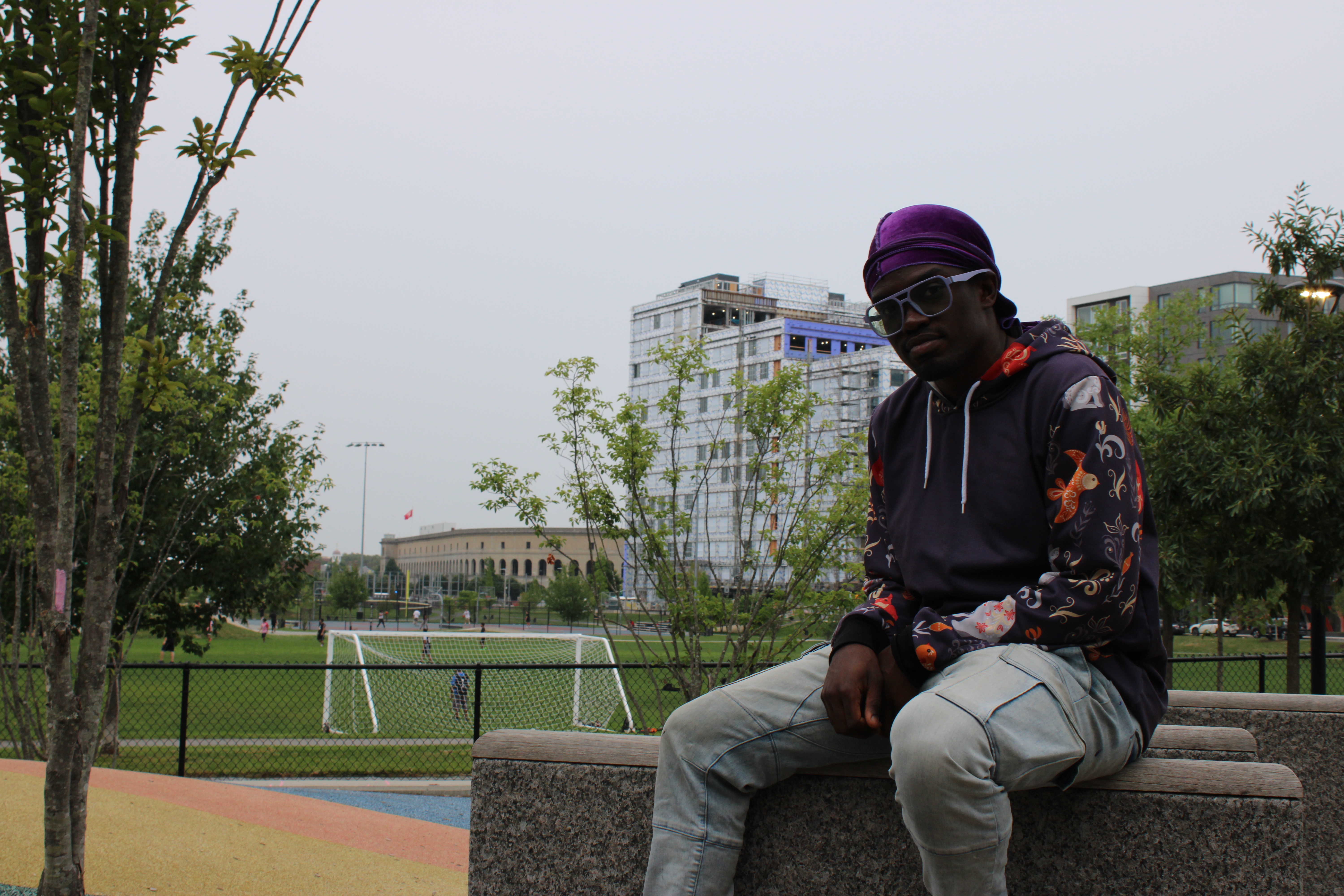
We’re at Smith Playground (235 Western Ave). A man with a skateboard walks by. He looks at Grey’s shoes and shouts, “Are those the Reebok Pumps?”
“They are, they are. I wore ‘em for you,” Grey laughs. The man thanks him. “You’re welcome, bro.”
He turns to me and says, “That is a lot more common than you think. I get that probably every other week. Any dude above the age of 35 who sees me with these shoes for the first time is like, ‘You got the pumps, man?’”
How did you first build your relationship with Allston-Brighton? My relationship with the neighborhood really started when I wanted to do political organizing. I was looking for a new career, and I had done canvassing for churches and for sales jobs, so that seemed like a good angle. Whenever you’re doing any sort of political organizing, they need you to know the place. You have to walk around the neighborhoods and figure out who exists, and go to public meetings.
Then, the pandemic happens. My board game pod was board games with my friends. As our pod started to expand — you can only play a board game like eight people tops — people are inviting their siblings and their college roommate or whoever to come hang out — we just started throwing parties.
I met a good friend, Natasha Zenos, nine months into doing this. After we had a big Halloween party, she had a zine that she was proud of and artwork from friends as she was finishing her degree at BC. She was like, “Yo, can I use your space to throw an event?”
After that, I started doing events, like at the house and in other places, and it really helps me connect to the arts and creative community in this neighborhood and, you know, around the city.
Was building relationships and friendships with other neighbors difficult when you first moved to Allston-Brighton? In the first couple months of me moving here, going and talking to people and trying to expand connecting to people became easier — it’s kind of a rich-get-richer situation when I already had people and friends and things that I knew.
My dad gave me some really good advice. On my first Christmas here, he came up and visited. He was like, ‘Hey. If you want friends in a place to hang out, you have a big living room.’ I lived in an old house. Most apartments don’t really have a living room. If it’s a two-bedroom, it’s really like a one-bedroom with a living room that someone’s sleeping in, or a three-bedroom, they’re using the third living room. Every living room becomes a sleeping space.
I was fortunate to be in a place where that wasn’t the case. Because that was true, I had a place for people to come over. I like board games. I grew up in a family that was very anti-TV. Board games were a way for us to get together.
As I had people over, I was like, ‘Hey, you can come to my house and play board games.’ Or I talk to someone at a bar and they’re like, ‘I know about this show, or this group that meets up or whatever.’ And I build that into being part of this place.
Describe the events you have enjoyed running the most with Kinross Community Center. Slumber Party was the brainchild of one of the guys who would help me work this event. His name’s Gabriel del Rita, and he wanted to do a variety show around nostalgia and returning to childhood, places like the playground and returning to the levity of youth. We had our friends do some poetry reading, to sing and like, you know, put on some music, put up art and like set up.
We took everything down in the living room, and made it into a gallery space, and I emceed.
And last year, it was the third annual Slumber Party, and it had really come together, where the themes around sleeping over, having some comedy in there, and micro-games. Everyone’s sorted into a house, and they’re on a team. They compete with each other. It was fun.
I don’t think I was in touch or connected to who I am as a creative person before I moved to Boston and put on events, whether it is figuring out how to configure a living room into a gallery space, or figure out how to blend styles of music that even I wouldn’t be sure how to classify it into a genre. Or finding materials and painting in and using what is available to us to create artwork that we can show to our parents or put on our walls or cover blank spaces that exist around us.
A lot of the goal and the benefit for me in this has been outside of connecting the people and, you know, socializing has been like understanding who I am as a creative person, and helping to pull that out of other people and give them opportunities to engage in that.
What is the importance of third spaces such as Kinross — spaces to be able to express yourself socially and creatively? There’s a guy named Jonathan Haidt who wrote a book called The Anxious Generation. He speaks about the way that parenting changed about a decade and a half ago, and in the monitoring of children’s outside space. They do not have the opportunity to seek their own preferences. Your parents are telling you, “Go do this sport” — things are regulated or overseen in this way or that way. There’s always someone making sure that everything goes right and there’s no harm.
In that lack of creating space for you to make a mistake, you also don’t really learn how to grow and navigate and build confidence in yourself of overcoming challenges and obstacles.
If we don’t learn how to navigate socially, make mistakes, get better, compromise with people, come to consensus, it harms our ability to like, build social structure, and we’re seeing that in a lot of different ways right now. Third spaces to me — and you know, I also made my own mistakes in practicing and building this — allow you to connect with people who aren’t someone who you just work with, or someone who was in your specific major in college.
Understand what your differences are, understand where your similarities are, figure out how to navigate those awkward moments with people, and to be okay with either working through that and coming closer or working through that and being like, ‘Maybe this isn’t a person I like.’ That’s a very important practice to me if we’re going to continue to have a government, and schools that work socially. The backbone of the way we live is based in social structure. And third spaces are the practice space to do that well. And the less we have of that, the weaker, the more brittle our institutions.
What work did you have to put in to form community spaces like Kinross Community Center? Did it take courage to take that first step? Community is very innate, you know? We’re at a playground, kids are playing, and they will interact and engage with each other. Prior to the pandemic, Robert Putnam says the real dropoff point was when we had AC and radios. That’s where we basically fell into social decline. And honestly, I buy his argument in some ways, because you had to go outside if you didn’t have an AC.
There is a natural component of community is something we need, something we know we need, something that’s innate in our ability to do it, but we’re out of practice. The great social infrastructure of a lot of global history is religion. My parents were very active in church, doing couple’s counseling and having us socialize. Again, my family is very anti-TV, so a lot of my childhood was navigating, creating, engaging in some of these social groups.
People move in and out of Allston all the time. What about a community makes it so important for people to stay? I had a high thought, it was 2020, I was in my basement, and I was very frustrated by the level of decay. This is not to shame my landlord, because, honestly, she was awesome and barely raised my rent in the five years I lived there. I had this basement. It was obviously an old frat house, tons of beer cans and debris. The people who had moved in for a semester or a year and had thrown their stuff down there, moved, and never came back.
We needed a place to hang out, and that was 800 square feet of space to hang out in, but it was just gross. I just had this thought where I could be really upset about the level of decay that my landlord, or anybody else who’s lived here has left this space in — and then had nothing or I could do something about it.
I could take ownership of this thing, even though I don’t own it. People did ask me if I owned it, which was funny. I was like, this house is a million dollars. You think I’m 28 and I own a million-dollar house? That’s crazy. But I got asked if I owned it so many times. But I could take ownership, clean it up, invest in it, sacrifice my time, energy, even some money, and make it a space that was beneficial for me, my friends, and my community.
The investment was for my social circle and friends, but it expanded beyond that and became something a lot of people in the neighborhood got to enjoy. Anytime you invest in something, you gain value for it. My first bike was free, and I didn’t really care about it. My current bike, I lost the previous one, so I had to spend money on it. Now I maintain it, check the tires, and take it to the shop.
Having to spend and sacrifice for something gives it value.
So in the time I’ve spent giving my time, energy, and money to the creative and arts and social scene here, I’ve gained perspective and care for the neighborhood.
Despite the transience of it, and this generational conversation about ownership — because basically everyone under the age of 40 feels like they will never own a house — you can still take ownership of the spaces around you. You can spend time investing and developing the things you care about, and whether or not your name is on a lease or a deed, there are places that people now associate with you.
There are places people see you being responsible for, a leader or a diplomat of.
I think of Sam Fish’s artwork right there, and Exit Galleries (99 Franklin St), which is a great space for people around the city to host listening parties, get coffee, and show artwork. I think of Ricky Meinke, who is doing the Rat City Arts Festival, creating a hyper-local music festival for the neighborhood.
Do they own their houses? Do they own the neighborhood? I’m pretty sure they’re renting the spaces they use for these events, but they have ownership in the neighborhood. They have investment in the neighborhood, and that is valuable.
I see a lot of people doing that. Those are just two that come to mind, but the more people do it, the harder it is to remove them from the place, even if they’re not physically present. And a lot of times, even if they’re displaced because of rent, their impact remains.
Do you have plans to get out of Allston-Brighton? Every winter I would go, why did I sign this lease? It’s dark, it’s cold, I’m miserable. Why am I in the city? Then May comes around, and I’m like, “Oh, yeah!” And then I sign my lease again. At this point I’ve gone through this conversation six times, and I don’t really see myself leaving. This is a place I want to be in. I want to settle down here. I want to really build ownership beyond some of the things I’ve already talked about, and I’m scheming and figuring out ways to make that a reality. This is now home for me in a way that hasn’t existed since I left my parents’ house.
Going back to Kinross Community Center — people discover it naturally, organically. Was that intentional? A hundred percent. So I had come from a background in political organizing. While a lot of my events are geared towards, and have been focused on, putting on local artists and showing visual art and a lot of social engagement and practice. That’s my background in psychology and social work. I’m very about figuring out ways to help people connect, and that’s a big purpose for me. Another purpose is to drive some of that into political activism. A lot of the messaging is you’re engaging so that you build your agency, so that you then develop the world in a way that you find beneficial.
Politics is not the only way to do that. Elections are not the only way to do that, but they are a start. We’ve got campaigns happening right now with the mayor’s race, and I was doing stuff with the presidential election, but there’s always ways to be involved around the production of housing in the neighborhood, how we determine where our park spaces are. There’s the city’s participatory budgeting process of voting how we use some of our money. These are different ways for you to take your agency and build into the social structures that exist or create your own.
It’s hard to share that message and engage in that message in the shadows. I understand and empathize with people who are creating venues underground explicitly to not have to deal with police officers, not have to deal with noise complaints from neighbors, and not have to deal with scaling. We see tech entrepreneurs struggle with this all the time. I was talking to a good friend of mine at MIT about this two days ago. Every time someone builds a tech platform around socializing, they come up with an interesting concept, then they scale fast to make money, and break the whole process. Scaling your audience beyond your friends requires understanding what values we have in common, what our goals and boundaries are, and what the purpose is for us getting together. There are a lot of intangibles about how you move together fluidly as a social group that you then have to legislate, write down, go through tough moments when people are not honoring that or making mistakes. If it’s just you and your friends underground, you don’t have to deal with that the same way. I get that, but part of my work is working through that and building on that and developing that, learning for myself, helping other people learn. You have to be above ground to have exposure in that way.
Are there moments that you have had in Allston-Brighton or at Kinross that felt like true community? I met this incredible guy. His name’s Corbin Swain. He’s a doctorate from MIT, and I met him outside of his academic prowess, because he was organizing a vigil for a woman named Toyin Salau. She was a Black Lives Matter activist who was killed by other Black Lives Matter activists in 2020. He created a space that was really valuable for me in checking misogyny. We were having a very large cultural moment around how we’re understanding and dealing with racism and police violence in this country, and the deeper level of misogyny that exists in and around and throughout all of these spaces, independent of, but also overlapping with.
It was a vigil. I did go. Swain created this very serene and reverent moment in a way that I normally don’t have access to, because I’m not going to church the way I used to as a child. It was really helpful in having a conversation without being in someone’s face, about me as a Black man, the way that I am thinking about my privileges and my assumptions as a man. I went to a college that was 80% male, and was pursuing a career path that was also 85% male. These aren’t things that I was thinking about at all. This was an eye-opening conversation and something that I had to learn. I’m going to have to learn and think about these things for the entirety of my life. I’ve never been a woman, but he created this moment that was really powerful, educational, developmental, and open.
Sometimes you have a conversation dealing with a topic that is hard, or challenging, or easy to make you defensive if it’s not something you’ve engaged with before. This had none of that. I think I err on the side of not being great at the reverence piece, but I err on the side of the openness and serenity and fun piece.
Learning when someone is throwing information at you is helpful if you want it, but for people who are not open or have not considered it before, sometimes you just have to show them. Sometimes they just have to be in the space. Sometimes they just have to engage with it without even having a cognitive moment. Then it’ll sit into the other things that they do.
Do you think it’s difficult to create a space like that — the one that Swain made — with openness or serenity? I think anything can be challenging. It depends on who you are. I’m blessed. I’ve always been a great runner. I run two to three times a year. I’m going to do a 5k in Mattapan probably on Saturday. It’s not going to be hard for me. Not everyone is built where they’re a good runner. This is not a brag. There are things that I am terrible at, one of them being on time. I have really aggressive ADHD, and it’s really hard for me to be on time in the same way that it’s really hard for people to run, in the same way that it’s really hard for people to be vulnerable.
Just because it’s hard doesn’t mean it’s impossible. I went to a festival this summer, and I watched some of the development in the social space they were creating, and I had this revelation. You can create any space if you’re committed to continuing to work on it and continue to show up for it. Even when I think about Kinross and the hard moments we’ve had about different roommates, different conversations, different community partners coming in and navigating our space, and different visions on what we wanted our main angle to be from an art space, whether it was music or comedy or visual arts or poetry. There were lots of challenges.
The strength of any social organization I’ve seen, the strength of religion, is that people keep doing it.
Religion exists today because with whatever sauce they put in 2000 years ago, 3000 years ago, 4000 years ago, depending on what religion you’re talking about, people continue to show up for those organizations, make it a priority, and build into it. Creating a space that’s open, vulnerable, or reverent is possible if you’re willing to do it and keep doing it and not quit. It’s hard. Then you reconfigure it, you ask for advice, you study someone else who is doing it right.
What are your thoughts on the BU Commonwealth Avenue Goodwill? Can’t say it’s my favorite Goodwill, not my least favorite Goodwill. I don’t have strong thoughts because I’m not there too often, but I talked to the staff once or twice there, and they were cool. I will say I’ve gotten sucked into the Buffalo Exchange. I know I’m giving money to Brookline, but that’s valid.
Have you shopped at Vivant Vintage? I have. Probably some of the most iconic pants I’ve ever gotten are from there. They are real military pants, but someone dyed them purple. All of the different shapes and forms that are supposed to camouflage you are different shades of purple in them. Those are big pants for me.
Is there anything that I didn’t ask about that you want to say about yourself or Allston or spaces? I’m thinking of this metaphor of graffiti. This is kind of a questionable thing. I really dig graffiti. I’ve never done it.
When I first moved here, I went on a not-date with this woman who was telling me about the graffiti scene and the significance of style and the competition and the location placement and all these things.
Graffiti to me has always stood out as a really interesting art form because it is created in a place where it’s not wanted until it is.
You think about tourist destinations of cities, and they’re like, check out our art alley, which is essentially gentrified graffiti. Kids were tagging these different places. People hated it until they didn’t, and then it became the backbone, and honestly, an economic foundation for an area.
I think the Allston punk scene has always been that. You don’t need to be destructive. You don’t need to be causing decay or debris. In the way that I took ownership of my space, you asked about whether I think that’s a courageous thing, and I got a lot of advice not to do it. That advice was reasonable because it was challenging, costly, and stressful.
But I had a space, I took it, I did something creative with it, until it was a thing that I wanted. That’s how I see graffiti, and that’s how I see this neighborhood.
People are concerned about this question all the time.
If we don’t have third spaces, take one.
There are a lot of places where, if there’s an activity or a connection or a community or the next step of a gap in your life that you want, people aren’t necessarily giving that to you, and that doesn’t mean you shouldn’t have it.
This isn’t saying go steal everything you need, or break into unused lab space or anything crazy. But there are spaces that are begging for people to use them. I talk about Brighton Common being one of them, because I love Brighton Center, and I would love to see more foot traffic there. I’d love to see the businesses thrive. I’d love to see them redo the Warren building (335 Washington St), there will be new retail spaces, and I’d like to see investment in that place that’s not another bank when they ultimately develop some of that stuff into more housing.
What are the things that I want? What are the spaces that I want? Then I have some onus to take that for myself. I encourage people to take that from the neighborhood. Frankly, the neighborhood wants to give that to you, but you do have to ask, and sometimes you have to ask obnoxiously, and I think it’s to everyone’s benefit for you to do so.
