
|
Getting your Trinity Audio player ready…
|
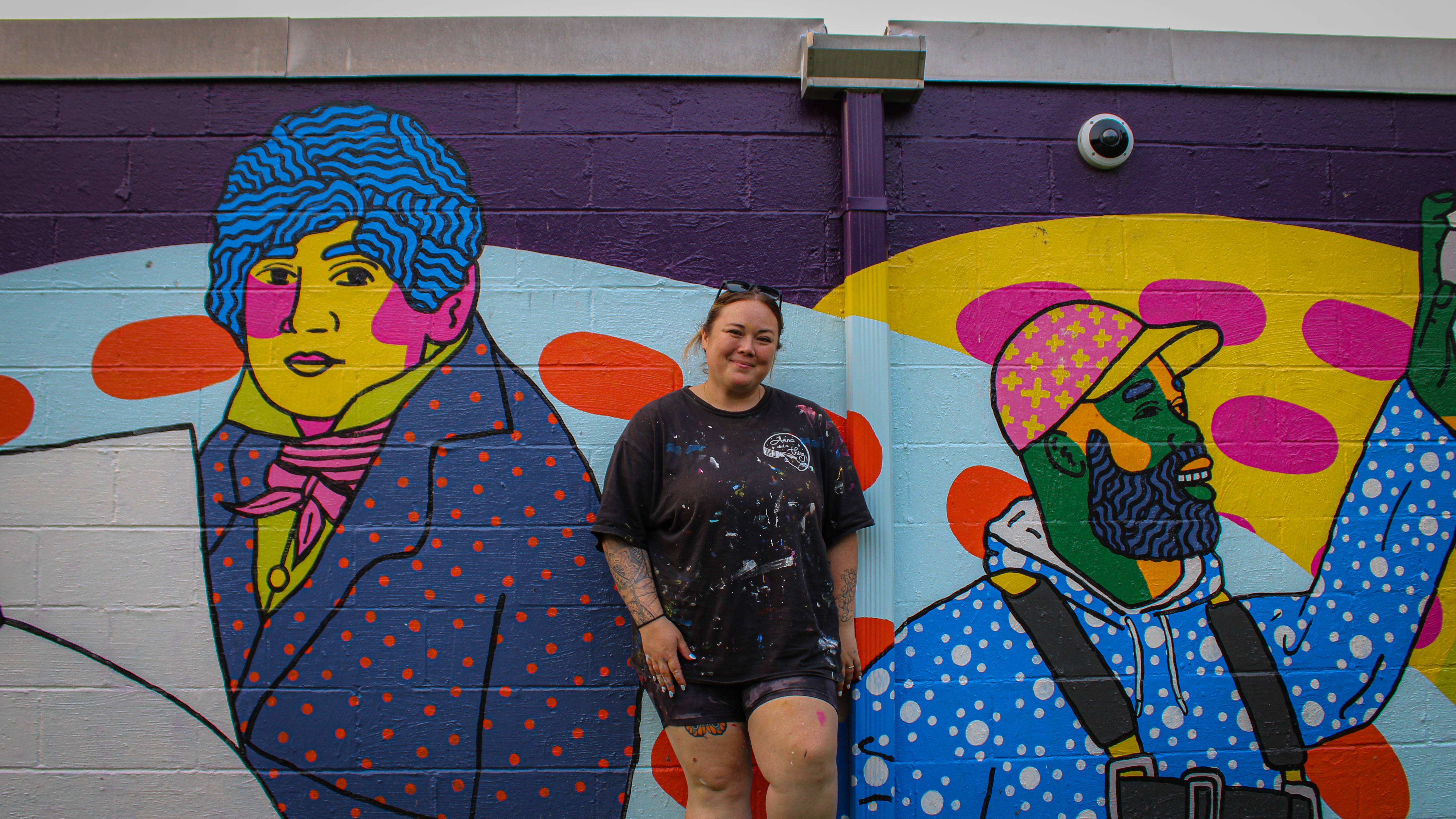
Anna Dugan and I meet in front of the Honan-Allston Library . She had just completed the first day of painting a mural in Brighton. A mark of an artist’s day of hard work, paint flecks her shirt like confetti.
We walk to a bench in Raymond V. Mellone Park. A few feet behind us, where dark grey expanse once was, Dugan‘s mural “LEARNING IN THE PARK” is striking.
This interview has been edited for clarity.
How did you approach the creation of “LEARNING IN THE PARK”? Zone 3 (267 Western Ave) was great about giving me general direction: “We want it to be about education, but we want you to take it in a direction that feels you, and how you would express what however you feel you can express that as a theme.”
I love portraiture. I love representing a lot of different people of different ethnic backgrounds, of different age ranges. Age is a big one for me, because I feel, in public art, people who do portraiture focus on young people — kids or young adults. It was important to me to have people above the age of 45 because I feel a lot of people don’t feel seen, or don’t feel important anymore, or don’t feel part of the conversation.
I wanted to express the different ways in which we learn. People’s ideas of education can be so narrow minded, where it’s books and that’s it, or research and that’s it. I’m such a tactile learner. I’m someone who learns through doing, through reading, through writing. If I can write notes and regurgitate them back at you, I know I’ve got it down. I learned the best through teaching as well.
It’s an homage to the different ways people learn, whether it’s through books or through writing or through art and music and STEM — all of that. It’s different age ranges in which learning is for a lifetime.
How did you use “LEARNING IN THE PARK” to engage with Allston? There were two community events that we did, one last summer, which was a mural unveiling. Within the unveiling, we did a community art project so we all created a piece of public art together that reflected the mural.
I really don’t align my practice with being an artist who comes in, saying, “I’m gonna paint this overnight and then leave and you’ll never hear from me again.”
I like engaging with the community. This past year — early spring-summer — we did a screen printing workshop out here, and some of the pieces of artwork were created into screen prints. It was really neat. Just to come back here, you’re constantly recycling the messaging and the work and engaging the community and creating those bonds and ties to the mural, but also allowing people to hear from the artist: what is the intention? What is the background? What are the stories of painting this? Who are these people and things?
So, who are these people in the mural? There’s, a number of real people and a number of people who are amalgamations of people that I saw, either online or in the community.
From all the way to the left — she’s not quite my grandmother, but I definitely took a lot of inspiration from my maternal grandmother. Then, the three kids, those are my two nieces and nephew. Then, the girl studying is made up. The man is made up with little bits of my dad, but not quite. The man painting is Washington Allston, the painter. Next to him is ProBlak (Rob “ProBlak” Gibbs), who is a Boston-based street artist. He’s incredible. He has paved the way for Boston-based street artists in so many ways, and I really look up to him and his work and his practice.

That juxtaposition of what art was when this place was founded and named versus how far we’ve come — the validity of street art versus classical portraiture, paintings or landscapes.
The rest are people that I’ve seen, mixed together. They’re made up, but they’re made up of people I’ve seen.
Do you just remember certain faces? Is it snapshots in your brain of how they look? It’s partially from photos online, from different organizations or different community events or restaurants. Sometimes I’ll just be out and about and, someone will just catch my eye, and I’ll just remember their general vibe or facial features.
How did you get into the world of mural painting? I have a BFA in graphic design from UMass Lowell, which I graduated in 2013 which feels like a lifetime ago. When I graduated, I actually only did one painting class, one true painting course.
I started college at Assumption College in Worcester. I was only there for one semester, because I didn’t really like the vibe. I took the one painting class there — they have basically zero art programming, but they had a painting class. I loved my professor so much. I took that class as an elective. I wanted to learn about painting.
I just went, “I want something that I’ll enjoy. Since I’m taking five classes, let me have one of them be more, passion-based.” And that one class made me go, “I think I need to study art.” Full send, study it.
I transferred all my credits in secret to UMass Lowell, and didn’t tell my parents until the day before I was supposed to go back to Assumption. I got my degree in graphic design, so I never took another painting class.
How did your background in graphic design help inform your approach to muraling? Having an education in art has been very helpful for the basic stuff: contrast and balance and composition and all that fun stuff. The graphic design portion has helped me with the creation of the murals, where I can digitally draw and illustrate on my iPad, and I can make mock-ups so that it’s to scale.
I’ll take a picture of this wall, and with the measurements, I’ll digitally make the artwork, plop it on the photo so that the client can see what it’s going to look like.
The other half of the education part that has helped me so much is that graphic design really teaches you how to take your ego out of things. A lot of times when you’re a graphic designer, you’re creating for someone else. You are a problem solver. It’s “here’s our brand,” or “I want a new website,” or “I want business cards,” or “I want my branding done.” It has nothing to do with you and your ego and what you want to do. You have to take the information that they’re giving you, of what the vibe is, what they’re going for, and the color scheme — and you are the one that does the Rubik’s cube for them and says, “Okay, here’s how it makes sense visually.”
With muraling, there’s many facets, where there are projects that are purely public art, that’s “hey, here’s a wall. Do whatever you want, whatever your heart desires.” I love those projects because I get to do a lot of work based on my family and my ethnicity and being mixed-race.
But then a larger portion of it is either commercial work, where you’re working with a brand and they’re like, “Here’s our brand. Make a mural within our branding guidelines.” So my ego is completely out of it, where it’s, “Okay, here’s the guidelines that I have to create something within, or something that was just in between.” This is me, but it’s also based on a theme that they are looking for.
My background in art and graphic design has very much informed this career path, but that’s a long-winded way of saying that I was not a muralist to begin with. I found muraling. When I moved to Salem in 2017 — I graduated in 2013 — it was four years later that I was like, “Oh, this is a thing that I could do.” It wasn’t until 2020 that I was a full time muralist.
How did you fall into this position of becoming a muralist? I wouldn’t say I fell into it, but it’s weird looking back.
I was 27 years old, looking at these walls in Salem and on the North Shore, in Lynn and all that, and going, “I don’t know how the heck you make that your career, but I’m gonna do that someday. And I don’t know how I’ll get there, but I’m gonna take the tiniest baby steps until I get there. I don’t know how, but I’m gonna do it somehow.”
And sure enough, I was working at a corporate job in Boston with benefits and paid vacation leave — all the benefits of working corporate.
I quit that job and I was like, “I’m gonna work at a restaurant, or I’m gonna work in Salem so I can walk to work, and the time it would have taken me to commute back and forth into Boston, I’m going to dedicate to making art. And I don’t know what’s going to come of it, and I don’t know how to pivot that into making murals, but let me just start there.”
I did the chalkboards at Gulu-Gulu Cafe in Salem, and I challenged myself to do a 100-day project. I went every day for 100 days — I’m going to come into this cafe and I’m going to do new chalk artwork for them for 100 days. They were really cool about it, because they’re like, “We get artwork, cool.”
You have to do things yourself — you have to get the ball rolling yourself and put yourself out there in that way. It was “oh, she’s a chalk artist, let me ask her to do some chalk art.” And then I would ask, “Hey, can I paint your window? So it’s not as impermanent as chalk, but it’s not as permanent as painting your wall.” So then it was, “Oh, she’s a window artist, let me see if she’ll paint our windows.” And then I started painting people’s windows and doing chalk art. And then I’d be like, “Hey, that wall of yours — would you want a mural? A more permanent mural?”
It just slowly but surely stacked on top of itself until I had enough of a foundation for three years of doing that on nights and weekends, sometimes even before hours before work hours. I would be out painting at five in the morning, like a crazy person.
In 2020 I got laid off from the job that I had, but I had built just enough of a foundation that I was like, “I think I could actually do this full time.” Once I went full time, it was, “Oh, I now have all the time to do bigger projects that I couldn’t take on because I had a nine-to-five.”
It really was a complicated, long odyssey to get here.
Was it scary making those changes? If so, why? Yeah, very. I am very lucky in that — when I quit my job in Boston, I was terrified — my husband’s very supportive. He was like, “Dude, I know you’re gonna be fine.”
I am a hustler. I am someone who works very hard. So I’m, if I have to wait tables, if I have to clean dishes, I don’t care. I’ll make rent. We’ll have food on the table, but I’m gonna make it work. I feel that mindset has taken me very far.
Every step has been scary, but I’ve been cautious enough. It’s doable, and I would do that until I reached this point where I was kind of, “Can I do this full time? Can I not?” The choice was made for me, because I got laid off, and that was terrifying, but it was the best thing that could have happened to me.
There’s a lot of artists in Allston. What would you say to these artists trying to get into their community and start building out a reputation for themselves?
Your work has value and you deserve to get paid for your work. It’s completely up to you what that looks like, but setting the standard for yourself is very important.
I remember feeling so weird, being in this in-between phase of, “I want to be a full-time artist, I want to be an artist, but I feel I’m not good enough to charge people yet.”
You have to get out of that mindset and just say, “No, the work is valuable.” At every stage, it’s valuable. Believing you have something of value is crucial, and presenting yourself that way to other people — not as someone who’s “hey, I’m just starting out so I’ll do things for free.” However you present yourself is how people will perceive you.
It is scary, but it is worth it. Persistence is key. Even if it’s micro steps, time is going by anyway. It’s not stopping anytime soon. If it takes you three years to get there, micro steps add up over time. As corny as it sounds, believing in yourself — “I’m worth being paid, I am worth getting the job” — taking the small battles of imposter syndrome every day, and saying, “No, I am good enough.”
You have to be well-versed in fighting those battles because imposter syndrome doesn’t go away with success. It gets way louder. So if you’re used to fighting it off, if you’re used to saying, “Shut up, self, you’re doing great,” as that voice gets louder, so will your confidence.
Why does your identity matter to your art? When you start making work of any kind, whatever your medium is — whether it’s writing, cooking, music, painting — artists typically start from within themselves. It’s, “What do I know? What do I feel?”
For me, I was very lucky to grow up in a household where my mom was always so adamant that we would be proud of where we come from: “Be proud of your Filipino heritage. Don’t lose it. It’s valuable and it’s special. The traditions and the culture are part of what makes you, you.”
When I look within myself, those are the loudest parts of myself — the fact that I am so proud of where I come from, and also that I’ve done a lot of introspective work on my experience of being mixed-race — what that has looked like and what it feels like. It’s something that’s so important to me.
I’ve found that whenever I would try to make work I thought other people wanted to see, I was never passionate about it, so I felt disconnected. It led to shallow interactions. It might be what’s popular, what’s on trend, but that’s as deep as it goes.
Once I started saying, “You know what, no. I don’t care about how many people like it or how many people identify with it. I want to make work that I identify with, that expresses whatever it is in here (gestures to heart), that’s when I started to find — particularly online — actual community”.
Who cares if you have likes and followers? That’s not what it’s about. I know people who have 100,000 followers — great, that’s awesome, and I’m sure you can monetize that. But the small community I’ve found that appreciates my perspective and the way I express my mixed-race experience, the way I touch upon culture, it’s an actual connection.
That’s one of the most powerful things you can achieve with public art, because it’s making art accessible. And when you make art accessible, that actually touches somebody. It’s not just “oh, that’s really pretty,” but it makes you feel something, where you can identify with it, or see yourself in it, or see people you feel you know. That connection is powerful. I don’t take it lightly.
I grew up in Methuen, and my K-12 school district had 6 Filipino kids, including myself, my sister, and my brother. At the time, on TV or in pop culture, you didn’t see Asian Americans, mixed-race people, Filipinos — definitely not. The closest I would get was Lucy Liu, and I’m not Chinese. She was the one token “generic Asian” woman on TV. So if I couldn’t find the representation, maybe I can make the representation, at least within public art.
I’ve seen the impact with my own eyes. I’ve seen kids run up and say, “That’s me.” I’ve seen people tear up. In Lynn, I remember painting a huge wall, a triptych of me, my mom, my grandmother. This girl came up while I was working on my mom’s portrait. She said, “Oh my God, I just moved here a few weeks ago. I’m Filipino. I moved from the West Coast, where there’s a huge Filipino population, and it’s felt like such a desert out here. I kind of felt like, did I make a mistake? Then you started painting this and I thought, that’s my grandma. It felt like a sign I was in the right place.”
We were both bawling on the street.
I don’t care if that mural only touched that one girl — it touched someone. That’s crazy, that colors and lines put together in a specific way could make someone feel at home. That’s the stuff that makes me say, I don’t take it lightly.
Even when I’m painting something without portraits — like the Brighton Pride mural — people are still connecting, pointing out landmarks, feeling pride. Public art does that. In a world where everything is clicks and scrolls, those in-person, human moments are more valuable than ever.
What made you gravitate toward community art over portraiture or graphic design? It’s something you feel in your bones when you find something that you’re meant to be doing.
I get this a lot from either friends or family: “You’re so lucky that you have a job that you love so much.” It’s true, but I think every career path, job or role that you have as a person has its challenges, but these are the challenges I’m built for. I am someone who will cry on a park bench in the middle of a park because I feel so much and I have the ability to create things that touch people.
It can be exhausting. It’s so hard on the body, and it’s so hard on you mentally, physically, emotionally, spiritually. At the end of the day, what I do is so gratifying, and I find so much joy in it and so much impact. It’s just something that I’m built for.
I feel it in my bones that community-based work in this specific way is what I’m meant to be doing. There’s been too many things that have aligned in certain ways where I’m in this position now, doing these things, and if I hated it, how did I get here?
It takes a certain amount of self-awareness to take the career jumps and know what you are meant to do. Sometimes, in life, I feel that people are not willing to or afraid to act on this awareness, this idea that, “Maybe this is my calling, but it’s risky.” I don’t blame people for that, especially the day and age we live in. It is scary. It’s like “girl’s gotta eat, you know?” I totally understand why people don’t.
I also think that a lot of people put too much pressure on themselves to love what they do. I happen to have a career that aligns with the life I want to live, the thing that I’m meant to be doing and makes me happy happens to be the thing that I have a career in.
I think there’s plenty of people who are meant to be working in corporate jobs, or honestly, just work a nine to five — get in, get out, because their calling is to, be an amazing volunteer or be this incredible mom, or be a figure in their community.
The goal would be to have something that you do that helps you sustain the life you want to live.
I happen to have a job that aligns with the life I want to live, but I know plenty of people who have a nine-to-five. They get to travel the world, they get to do all these amazing things, and that is what they’re meant to be doing. They’re doing it the right way, because they’re not so hell-bent on being like, “Yeah, but I don’t love my job. It’s not, I’m not passionate about my job.” It’s like, “You’re passionate about your life.” There’s a difference.
Have the job that allows you the flexibility to create the life that you’re meant to be living. I think that is also in some ways risky, but worth it.
What is it like seeing your art in public? It’s surreal because all the memories of painting it flood back. I’m like, “Oh yeah, I did that. This exists now. This is the background of some for some people’s everyday life.”
That’s a privilege. Whenever I revisit any work, I’m like “yeah. My hands made this.”
Do you have dreams of taking your art in other directions? I have daydreams about painting the side of a building. I have a lot of work where it takes up long horizontal stretches of space. I would love to tackle something vertical scale-wise, and something that’s a little bit more prominent. I have a lot of work that’s kind of tucked away — it’s the hidden gem kind of stuff — I really, really love that. However, I would love to have something that’s more vertical to balance it out.
I also would love to have the opportunity to do something like I did in Lynn. I love painting portraits of my family members and just touching upon my culture.
How do your family members respond when they see their faces in your art? Oh my God, it’s so funny. It’s such a mixed bag. The reactions are overwhelmingly positive, where people say, “Oh my gosh. You painted me!”
Some of the highlights of my career have been being able to show people that I care about, that I love very much, that they’re worthy of being depicted large-scale, in-your-face, colorful, bright and loud.
Growing up, I would be like, “I’m visiting family in the Philippines.” My classmates would be like, “You’re going to South Africa?” I’m like, “What are you talking about?” They didn’t even know where the Philippines was. Just bonkers.
We’ve come a long way. There’s many more Filipinos in prominent pop culture now, thank God. There’s still this cultural assimilation, where we can’t be loud and proud about where we come from. My mom was so staunchly the opposite, which I’m very grateful for.
Being able to depict my family members, who for large portions of their lives, they’ve just been like “no. It’s fine.” It’s like “hell no. You’re here and you should be proud and you’re beautiful. Our culture is beautiful, and we have every right to be loud about it.”
Is there anything that you want to mention about art or yourself that I didn’t ask about? I always have to mention my mom. My mom passed away last April, and it was awful and devastating. But every chance I get to mention her, I do because she was so not the stereotypical “you have an Asian mom, so you have to be a doctor.”
She so firmly believed in all three of her kids as people, not just as, “You have to be this, you have to be a lawyer or a doctor.” Don’t get me wrong, she would love that, but she was so supportive of every part of who you were.
I’m very grateful that I had parents to whom I didn’t have to prove that I’m going to make something of myself. They’ve been proud since I started. They were loud and proud about having a daughter who was an artist since I started, not just when I gained success.
If there’s anybody who could use that as motivation to be that person for someone else — I will always give people their flowers, for their dreams, for whatever it is that they’re trying to accomplish, and be there for them in a real way.
I’ll be realistic with you and say, “It might take a while. It took me a while. It might take you a while, but you can do it.” If you believe in it, and if you’re passionate about it, if this is something that you truly feel like you can do, you can do it.
I always encourage people to be that person for someone else, especially if you didn’t have that person. You have every opportunity to be that for someone else. It’s priceless.
