
|
Getting your Trinity Audio player ready…
|
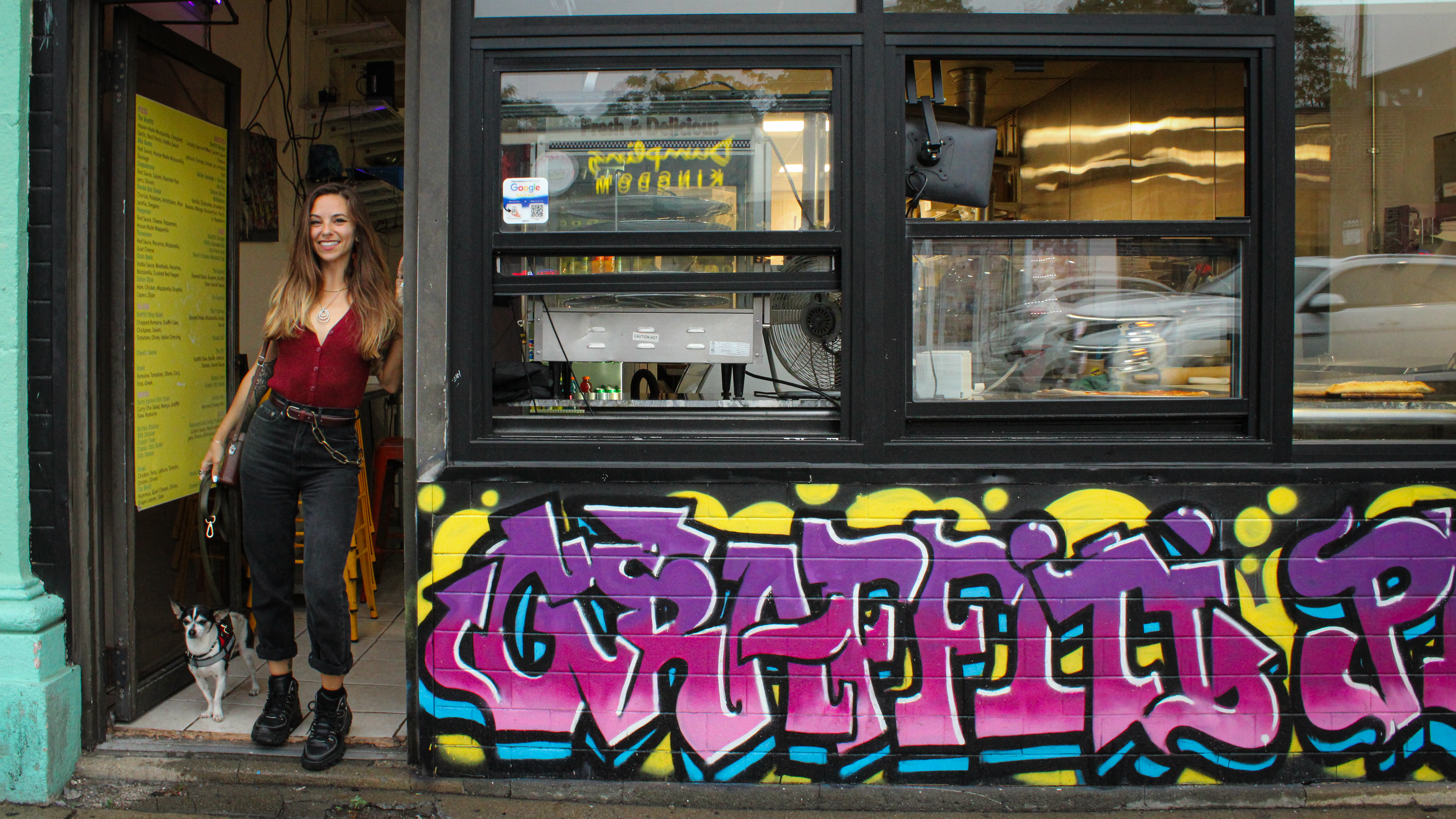
The sky is grey, but Allston is full of color. Graffiti Pizza’s purples, yellows, blues, and reds are as vibrant as ever against the stormy, rain-slicked streets. I buy a Fruit Punch Jarritos, which I sip on as Jill Rosati and I speak.
This interview has been edited for clarity.
How did your relationship with Allston first form? I grew up in Greater Boston, and I came to Boston University when the year was 2012. I feel like I grew up here. This is where I became who I am.
Tell me what it was like being a student and artist in Allston. I bought all this black plastic and turned my room into a tunnel to get to the sun room. And I lit it weird. I played this noise machine CD that had all these different samples you would use in a movie or something. There’d be strangers just talking there and I’m like, “You’re in my bedroom.”
It’s just always been such a vibrant community. I was definitely weird growing up in the suburbs, being an art nerd. Emphasis on nerd. I definitely felt at home as soon as I started making friends in Allston, seeing different ways of people living.
How did you begin to find community in Allston’s arts scene? House shows were a big part of why I felt so madly and deeply in love with Allston. My friends and I went to house shows all the time. You could pretty much go into any basement and see an art show or poetry reading or some dude on a guitar and someone in their underwear rolling on the floor.
How did you begin making public art in Allston? Allston Village Main Streets (161 Harvard Ave #11) has been my ride-or-die through it all. They hooked me up with a lot of awesome things. I started because I wanted to paint Ringer Park (85 Allston St). I used to live at Ringer Park, and I used to play basketball in the morning or baseball with my roommates.
Living next to Ringer Park was awesome. I would wake up to a marching band across the street. I would fall asleep to fireworks. It was amazing. I would hang out there at nighttime and make new friends from all over the neighborhood.
The green wall at the tennis courts was always falling apart and not looking so great. I taught at Jackson-Mann K-8 School and Community Center (40 Armington St). I connected with the kids, and I just saw how the Jackson-Mann was running, and I was like, “This is crazy that these elementary school kids are having recess at this place where college kids are going to drink and smash bottles, you know?”

Seeing that the kids at the community center and the elementary school didn’t really have nice, clean places to be kids that was important to me. I wanted to make a visual environment that feels safe for kids and not somewhere you could step on glass.
Does teaching art affect the way you make art? It really does. With my art, I used to be so exact. I’d make measurements, and I was very particular. For the eight years I taught art, I was learning from the process of watching the kids make art. They were so free, and their stuff came out so vibrant, and that 100,000 percent translated into the way I do my work.

I was a lot less strict on myself. I was having more fun and experimenting. And making a painting wasn’t like, “Oh, I need to use oil painting. I need to spend a million hours on it.” I was free. And I switched to acrylic, and I had more fun. Play and fun is an important part of making art.
What is the importance of public art in a community? The visual environment that kids are growing up in — it helps community members respect the community more. I don’t know for a fact, but I would say that ever since we fixed up Ringer Park, there’s less broken glass, there’s less trash.
People see that the space is being taken care of. In turn, they want to take care of that community.
What has your process been like for each Allston public art project you’ve done? When I’m working on public art for a business, I work closely with the shop owner.
For the Ringer Park mural, we did a voting event. I put out flyers everywhere. I was on a scooter with a broken foot, and I went to every house on the whole block. I delivered flyers. I put on this event — we had food, we had tables, we had vendors, and we got tons of votes. The one that won was actually cool because it was based on my experience wandering around Ringer Park, through its paths and its little forest areas, feeling lost in its beauty.
At Groovy Thrifty (64 Brighton Ave B), they had this gray utility box — kind of ugly — in front of their shop. Groovy Thrifty is hidden. It’s underground. Putting the arrows on the utility box and making it very vibrant, we were aiming to bring the inside of the store outside, so from the street, when you’re walking by, you can get an idea of what’s in there. They have lava lamps, funky, seventies, retro thrifting stuff, so it’s cool.

It’s the same with Graffiti Pizza (136 Harvard Ave). They were painting over the graffiti in front of the pizza shop, and they needed something to get people’s attention.
Did you incorporate community artmaking into your mural painting? Yes, I did incorporate a paint-by-number on the initial sketch of Ringer Park.
Even for Graffiti Pizza, I invited several artists to paint on the side of the wall as well and we made a day out of it. Dave from Graffiti Pizza was nice enough to even cater!
When you bring a lot of people together and they enjoy themselves, those feelings are always reflected in the artmaking. You can see the energy in the final result.

What do you hope to share with the public through your murals? Capturing the culture of a community is very important.
When there’s no art, it’s like nobody lives here. Being able to get a glimpse into what the community is all about — I like to portray that.
What’s the story behind Arts District Boston? That was started during COVID-19. I was feeling so sad because I couldn’t go look at art, and I actually made an art piece about it, too. I was so used to just going out, seeing art all the time, connecting with the artists.
There was none of that because we couldn’t have events. I started Arts District Boston as a way to spotlight artists of all different backgrounds, all different ages. We had people aged from high schooler to 60-somethings.
I would invite artists to teach classes and talk about their artwork. We were doing it multiple times a week. At the peak, we had an event every day of the week. It was Sketchbook Sundays. Then we had Music Mondays. We had Tutorial Tuesdays, then we had Artist Interview Thursdays,
All the work I put in looking up new artists and sharing their work, it filled that void of needing to connect with art and connect with the art world.
Where did @acidplaydough come from? I was doing a lot of sculpture, and I was just thinking like a trippy sculpture or if you were making clay, and it started burning your fingers. People complimented it, and I was like, “All right, I’ll stick with it.”

Do you have any favorite spots in Allston? Ringer Park is my favorite. I love all the mala restaurants. I’m a sucker for spicy. I will eat the crap out of it. And I love that I come to Allston every time I want to eat. It’s got the best food in the world.
What’s the feeling of seeing your art in public? A little embarrassing! I hate it!
No, I’m definitely very proud that I have the opportunity to express myself and proud of the work I do.
Do you have any plans for other things that you want to do? Yes, I have. I just got a grant. We have another mural coming up for sure, and possibly a community art show.
A common thread that I’ve noticed is that the art that we’ve been talking about is about people and art, and the relationship between a community and art. The social aspect of art seems so important. I feel so seen, yeah! Art has the ability to connect people from all walks of life. It’s a way to bring people together.
